

The first time I went to Mackinac Island, I was in third grade—small enough that the ferry felt like a voyage to another country, big enough that I knew I was somewhere different, the moment the dock came into view. I didn’t have the words for it then, but I do now: the place feels like a living memory.
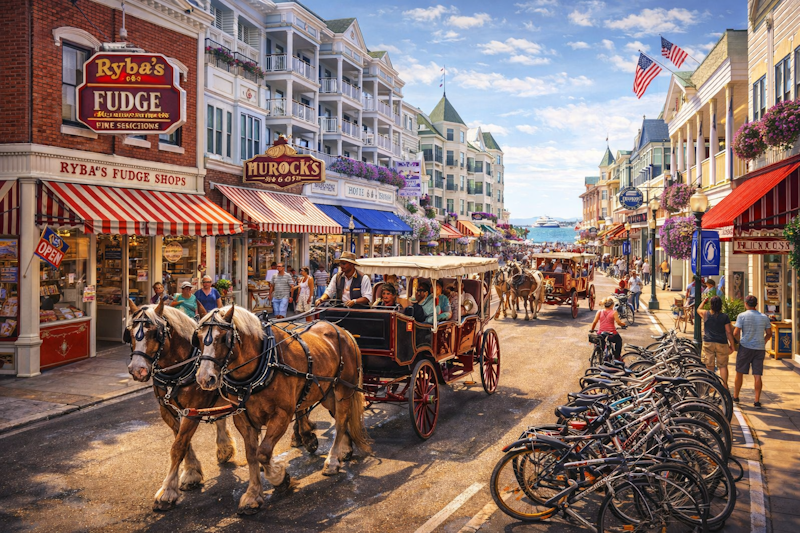
Back then, I remember the island arriving in pieces—wind off the water, gulls and chatter, storefronts that looked like they’d been waiting all winter just to open their doors. And then the sound that still tells you you’re truly there: horses. Not a novelty, not a staged attraction, but a real working rhythm—hoofbeats and harness jingle, the steady, practical music of getting around on an island that decided long ago it wouldn’t surrender its streets to engines.
I’ve been back plenty since that third-grade trip. I’ve taken my wife to stay for anniversaries, the kind where you don’t need a packed itinerary because the whole point is to slow down. And now we take our kids, which is the sneaky magic of Mackinac: it lets you visit your own past while you’re making somebody else’s first memories at the same time. You watch them look at the island the way you once did—eyes wide, attention snagged by details adults forget to notice.
That’s when it hits me, every time: Mackinac Island isn’t just a destination. It’s a decision.
A place that said “no” to cars—and meant it
Mackinac Island’s refusal to allow most motor vehicles isn’t a marketing campaign; it’s policy with deep roots. Village leaders enacted the ban on July 6, 1898, and the island has been car-free ever since.
There are exceptions for emergency and service needs, but for the rest of us, arrival is a clean break from the mainland’s hum. You step off the boat and you’re instantly on foot, or on a bike, or in a horse-drawn taxi. The difference is more than transportation—it changes how you pay attention. You’re not scanning for parking or timing traffic lights. You’re looking up at porches and dormers, watching the way sunlight slides over Lake Huron, noticing the lilacs when they’re in season and the way the air smells after a shift in weather.
The island forces a kind of presence that modern life constantly tries to steal. It’s hard to stay in a hurry when the streets move at the speed of hooves.
Where the Great Lakes meet, history concentrates
Mackinac sits at a crossroads—geographically and historically—between Michigan’s two peninsulas, at the strategic Straits of Mackinac. That’s why so much of the island’s story is about control, commerce, and the push-and-pull of empires that wanted to own a gateway.
Fort Mackinac, the cliffside sentinel many visitors tour today, traces back to the American Revolution era. The British moved their fortification from Fort Michilimackinac (on the mainland at what’s now Mackinaw City) to Mackinac Island in 1780 because they believed the mainland site was too vulnerable to attack. Americans took control in 1796.
Standing there now—cannons pointed toward the water, limestone walls holding back centuries—you can feel how the island’s calm is layered on top of a much louder past. It’s easy to visit for fudge and bicycle rides and never think about geopolitics. But the island is a reminder that the Great Lakes were never just scenery. They were routes, riches, leverage.
And Mackinac still looks the part: bluff-top views that make you understand instantly why someone would’ve wanted the high ground.
A park that takes up most of the island
One of the island’s biggest “aha” facts—especially for first-timers—is that a huge portion of it is protected land.
Mackinac Island State Park was established in 1895, making it Michigan’s first state park. Before that, for twenty years, the land had been Mackinac National Park—recognized as the United States’ second national park during that period. Today, over 80% of Mackinac Island is state park property, much of it kept in natural condition.
That explains why even when the downtown is busy and sunburned and sweet-smelling, you can get on a trail and be somewhere quieter in minutes. Forest. Limestone formations. Big sky. The island’s famous landmarks—natural rock features and shoreline overlooks—don’t feel like something added onto a resort town. They feel like the whole reason the town exists.
The best days I’ve had there, honestly, aren’t the ones where we tried to “do everything.” They’re the ones where the schedule was simple: bike ride, stop when we feel like it, hike a little, let the kids climb (safely), and end up somewhere with a bench and a view that makes time behave.
The Grand Hotel and the art of arriving
Even if you’ve never stayed at the Grand Hotel, it has a gravitational pull. You see it and you understand why people dress up a bit more on this island than they do anywhere else in Michigan. The building is part landmark, part mood—an institution that helps Mackinac keep its Victorian-era flavor without feeling like a museum.
It’s one of those places where the act of arriving—by carriage, by foot, by bike—feels like you’re participating in a tradition. And tradition matters here. It’s in the architecture, the manners, the way the island asks you to slow down and look around.
Fudge as a souvenir, yes—but also as a story
Let’s talk about the thing everyone jokes about and everyone buys anyway: fudge.
Mackinac Island’s fudge reputation wasn’t inevitable. It became part of the island’s identity over more than a century, shaped by entrepreneurs and the island’s evolution into a resort destination, with showmanship playing a role in turning a candy business into what it is today.
That’s what makes it feel so “Mackinac.” It’s not just that you can get fudge. It’s that you can watch it being made, smell it being cut, and carry it out the door like a trophy. The island’s candy shops are both confectionery and theater—windows fogged with sugar perfume, slabs cooling, tourists lining up like it’s an attraction (because it is).
When I was a kid, fudge felt like the main event. Now, it feels like part of a bigger pattern: Mackinac has always been good at understanding what visitors want to take home. Sometimes that’s a box of sweets. Sometimes it’s a story. Often it’s both.
It’s not just beloved—it’s nationally recognized
If you’ve ever wondered whether Mackinac’s popularity is just a Michigan thing, the rankings say otherwise.
The Mackinac Island Tourism Bureau lists multiple recent awards from USA Today’s 10 Best Readers’ Choice Awards, including being voted #1 Best Summer Travel Destination in both 2023 and 2024.
Regional and national coverage has echoed that recognition, noting the island’s #1 “Best Summer Travel Destination” placement for 2024 in USA Today’s 10 Best Readers’ Choice awards.
In other words: it isn’t only nostalgia talking. People across the country are voting for the same thing we keep returning to.
And Mackinac keeps stacking accolades. The tourism bureau’s own roundups also point to recognition in Condé Nast Traveler’s readers awards conversations and other national lists that treat the island like an outlier—in the best way.
Why we keep going back
Here’s the part that feels less like a travel brochure and more like a family tradition:
Every time I take my wife back for an anniversary, I’m reminded how rare it is to share a place that stays meaningful as you change. The island meets you differently depending on your stage of life.
- As a kid, it’s wonder: horses, bikes, forts, candy, the sense that rules are different here (because they are).
- As a couple, it’s romance with training wheels removed: you can’t “run errands” in a car, so you actually spend time together.
- As a parent, it’s a gift: a vacation where the boundaries feel safer, the pace is gentler, and the distractions are better—nature, history, movement, sugar.
The car ban is the headline, but it’s also the mechanism. Mackinac doesn’t just avoid something; it creates something by avoiding it. That’s the decision I meant earlier. The island chose a slower mode of life in 1898, and it’s been cashing the interest ever since.
When we bring our kids now, I catch myself watching their faces at the same moments I remember from my third-grade trip—stepping onto the dock, hearing the first carriage roll by, seeing the fort up on the bluff like it’s guarding time itself. And I realize Mackinac Island isn’t frozen in history. It’s actively preserving it—by making you live differently while you’re there.
You can visit for a weekend and come back with fudge and photos. But the real souvenir is subtler: a reset in how your days can feel.
And once you’ve had that—even once, even in third grade—you end up wanting to return, again and again, to the little Great Lakes place that still believes clip-clop speed is fast enough.