



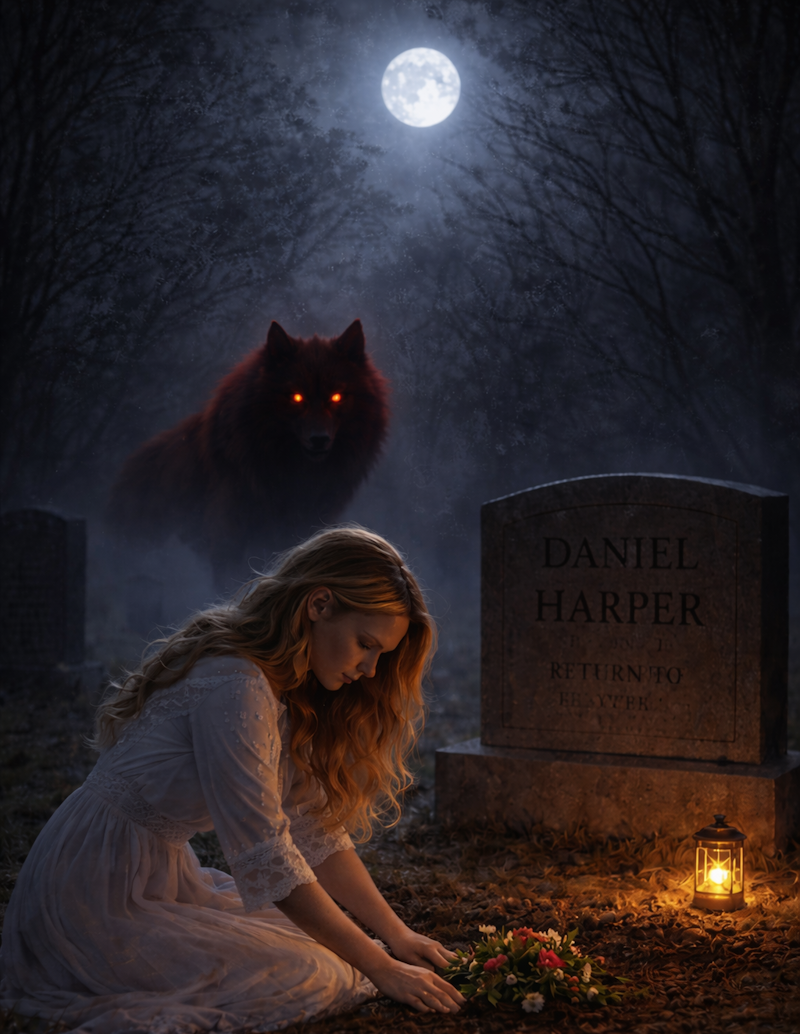
(work in progress)
The air in the funeral parlor was thick with the scent of lilies and polished wood
A young woman sat stiffly in the velvet chair near the casket, hands folded tightly in her lap, staring down at the man who had been her world. He was gone.
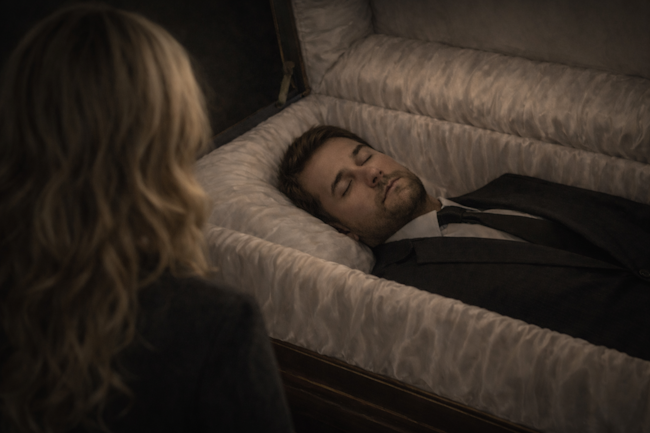
The room was silent, too silent. Outside, the gray winter sky pressed against the tall windows, letting in only the pale light of the late afternoon. She could hear her own shallow breathing, the faint drip of condensation from the old radiator, the ticking of the wall clock. How could this happen? They were too young, too full of life. He should have been there to laugh at some stupid joke or to warm her hand when the wind cut too sharp through winter night.
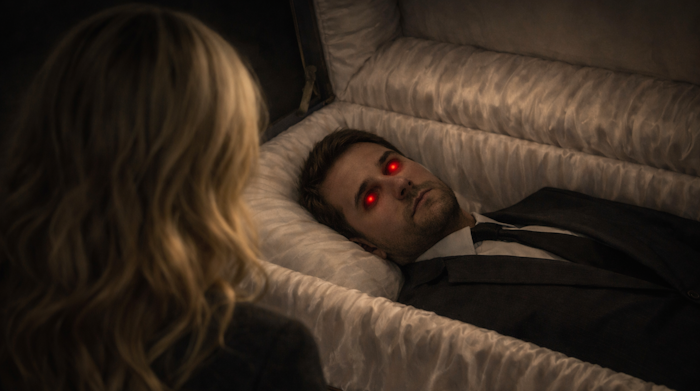
She caught herself staring blankly at his face remembering when life made sense, A strange and sudden feeling raised the hair on the back of her neck, and her chest tightened. As she leaned closer to the casket his Daniel’s eyes shot open. Glowing red. Hannah gasped, recoiling, her heart hammering so loud she was certain that she was going to have a heart attack. But when she blinked… nothing. Just the pale, still face of her husband.
She shook her head. “I must have dozed off,” she whispered, clutching her chest. And then came the whistle of the teapot from the small kitchen off to the side of the parlor. The sound pulled her from the nightmare-like vision, grounding her in the cold, quiet reality of her situation. Mourners will be arriving soon
A door creaked, and footsteps echoed across the polished floor. The murmur of voices followed, polite and sorrowful. People she recognized—and some she didn’t—entered the parlor one by one. Mr. Whitaker from the bakery nodded solemnly as he approached her, his hands wrapped in a wool scarf. “Hannah,” he said softly, and she realized with a jolt that she hadn’t even acknowledged him. Her name, spoken aloud, seemed to confirm her presence in a world that felt tenuous and unreal.
The town’s familiar faces flowed in. neighbors, friends, acquaintances. There was Mrs. Callahan from the diner, with her usual sharp-edged sympathy; the pastor, quiet and tentative, holding his hands together as if hoping to ward off some unseen darkness; young Tommy Reeves, holding a single wilted flower too large for his small hands. Each of them carried the same look—part grief, part curiosity, part unspoken fear.
Hannah gave small, polite nods, murmuring thanks as each visitor approached. She felt like she was moving through fog, the room distant, unreal. But behind her eyelids, she could still see that red glow. It flickered at the edges of her vision, impossible and lingering. She forced herself to focus on the small details: the worn pattern of the carpet, the faint smell of coffee and wax, the way the winter light angled through the curtains just right to make the polished wood gleam.
And somewhere in the corner of her mind, a voice whispered, low and hungry, a voice she couldn’t place—couldn’t even tell if it was real. She didn’t know it yet, but the full moon had already begun to pull at the edges of her world.
Hannah stepped out of the funeral parlor and into the gray chill of the late afternoon
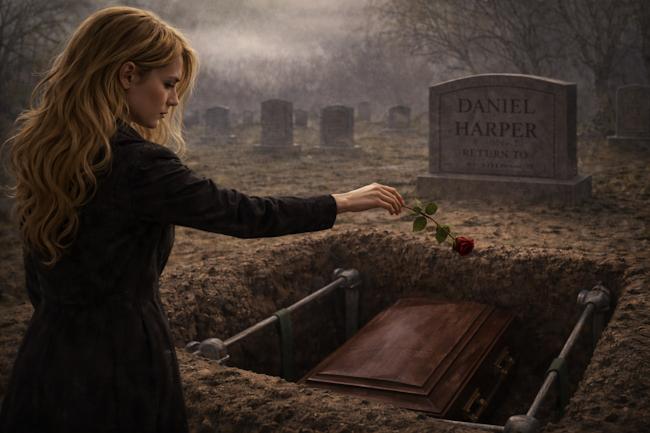
The grass crunched under her heels as she made her way toward the cemetery, carrying a single red rose. The wind cut through her coat, sharp and cold, but it barely registered. All she could think of was him, the hollow space where his presence had been.
At the gravesite, she knelt, careful not to disturb the frost-hardened earth. The mourners had already begun to gather around the grave, their voices low and retreating. After the last words, Hannah extended her hand, letting the rose slip from her fingers onto the casket as it was lowered. A soft thud echoed in the quiet, and her eyes blurred with tears. She whispered a single word she couldn’t bear to say aloud in front of anyone else.
Turning from the grave, she began the slow walk back toward the main road. A few townspeople lingered, nodding politely or offering quiet condolences. Mrs. Callahan from the diner pressed a hand to Hannah’s shoulder. “You’re strong, Hannah,” she said softly, but Hannah could only manage a shaky nod, her throat too tight for words. Mr. Whitaker, from the bakery, tipped his hat but didn’t speak, sensing the fragile shell of a woman before him.
Hannah wanted to tell them she was fine. She wanted to explain that nothing could possibly fix this day, that nothing could make it right. But the words lodged in her chest. She kept walking. The town’s streets felt emptier than usual, the snow-muted sounds of traffic and wind pressing in on her, keeping her company in a strange, hollow way.
When she finally reached her house on sixth St. the familiar brick façade offered little comfort. She fumbled with her keys, her hands trembling, and stepped inside. The warmth hit her all at once, but it did nothing to chase away the cold pressing at her bones. She sank onto the couch, coat still on, and let her head fall into her hands.
In front of her, laid on the coffee table, was the newspaper. The bold black headline caught her eye immediately, and for a moment, she felt her breath hitch. The world seemed to pause, waiting for her to read the words that might make sense of the senseless.
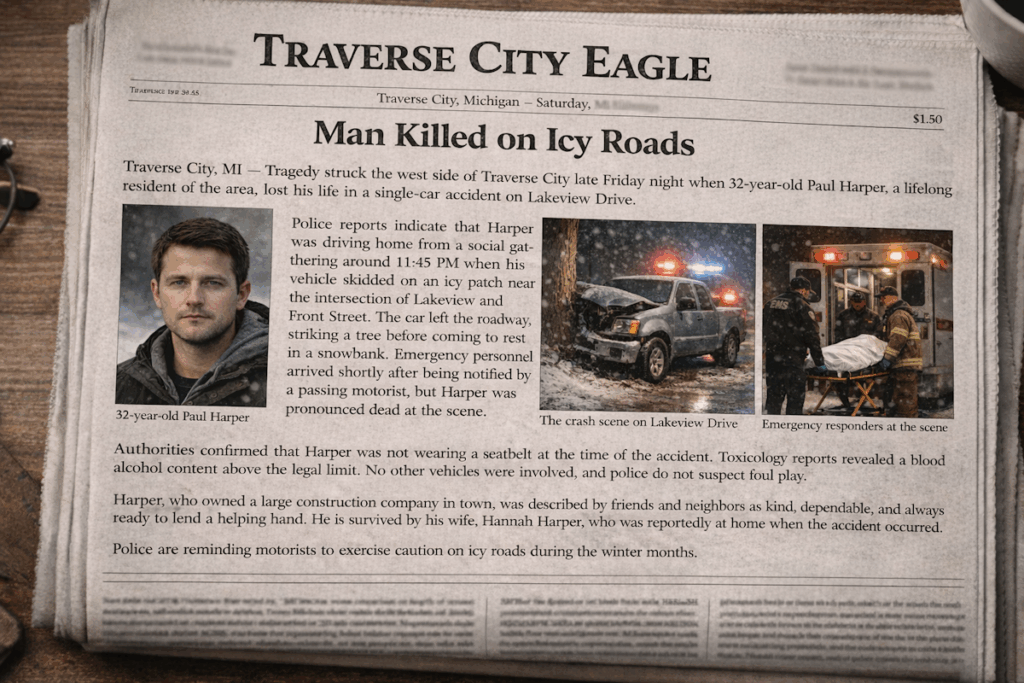
Traverse City Today
January 15th, 1999
Local Man Killed in Icy Road Accident
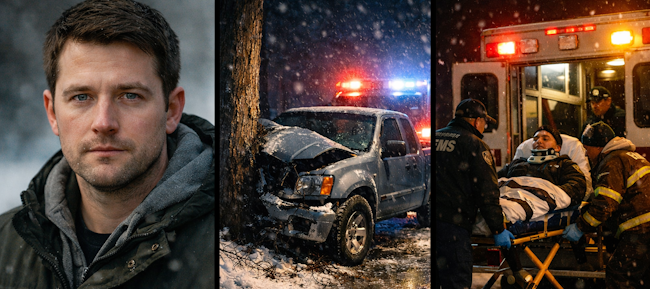
Traverse City, MI — Tragedy struck the west side of Traverse City late Friday night when 32-year-old Paul Harper, a lifelong resident of the area, lost his life in a single-car accident on Lakeview Drive. Police reports indicate that Harper was driving home from a social gathering around 11:45 PM when his vehicle skidded on an icy patch near the intersection of Lakeview and Front Street. The car left the roadway, striking a tree before coming to rest in a snowbank. Emergency personnel arrived shortly after being notified by a passing motorist, but Harper was pronounced dead at the scene.

Authorities confirmed that Harper was not wearing a seatbelt at the time of the accident. Toxicology reports revealed a blood alcohol content above the legal limit. No other vehicles were involved, and police do not suspect foul play.

Harper, who owned a large construction company in town, was described by friends and neighbors as kind, dependable, and always ready to lend a helping hand. He is survived by his wife, Hannah Harper, who was reportedly at home when the accident occurred.
Police are reminding motorists to exercise caution on icy roads during the winter months.
Copyright 1999- Traverse City Today
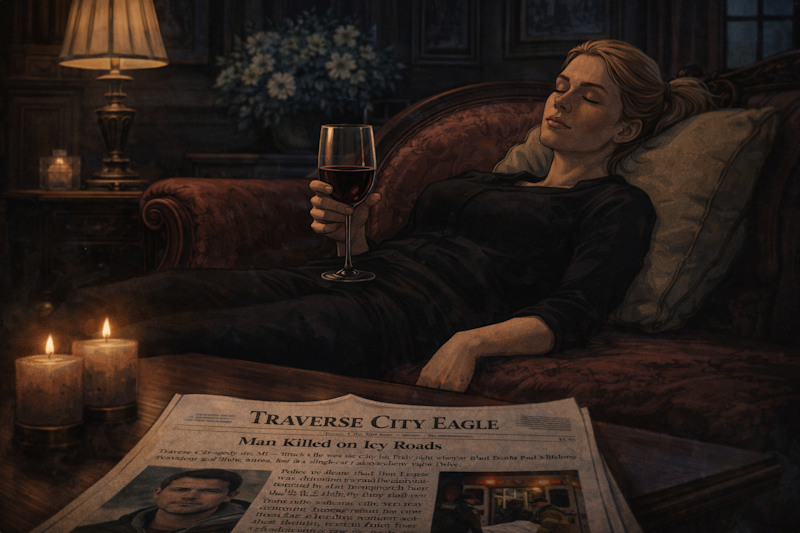
Hannah poured wine to the top of a tall glass. Trembling slightly in her hand as she carried it to the couch, the newspaper still spread open on the coffee table. She didn’t read it again. She couldn’t. She stared past it instead, into the quiet of the house, into the places where his voice used to live.
The first sip tasted bitter. The second went down easier.
Outside, the wind brushed against the windows, and somewhere in the distance a car passed, tires hissing softly over ice. Hannah leaned back, cradling the glass against her chest —Broken thoughts dominated the conversations in her head— With most of the wine consumed her eyes felt heavy. She told herself she would just rest them for a moment.
Just a moment
The room slipped away
She was standing in the cold
Snow pressed under her feet, untouched and glowing faintly blue beneath a moon too bright to be real. The air smelled sharp, metallic. Ahead of her, she saw it — the truck. His truck wrapped around the tree, its front end crushed inward, glass scattered across the ice like frozen stars.
“Daniel?” Her voice sounded wrong, stretched thin, as if the night were swallowing it.
He was sitting upright in the driver’s seat.
Relief surged through her so fast it hurt. She ran, slipping once, her boots skidding on the ice. “Daniel, thank God,” she cried, reaching for the door. “I’m here. I’m here.”
He turned toward her.
Hannah stopped.
Her breath caught in her throat as her body refused to move another inch. Where her husband’s face should have been was something else entirely — a dog’s face, elongated and wet, fur matted dark around the mouth. Its jaw hung open slightly, teeth too large, too many. And its eyes—
Glowing red.
They locked onto her, unblinking, knowing.
The thing in the truck smiled.
Not with kindness. Not with recognition. With hunger.
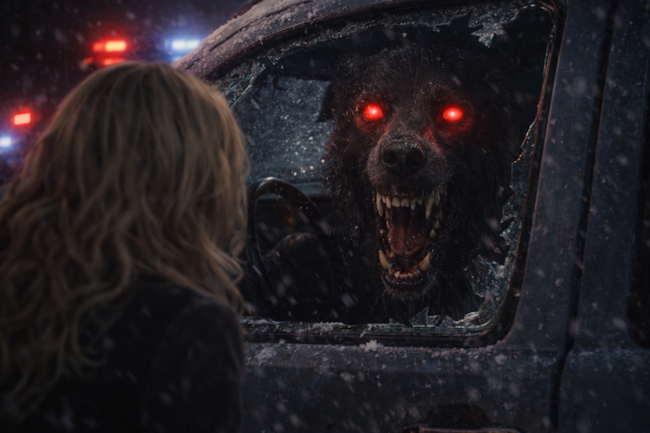
Hannah tried to scream, but no sound came. The snow around her feet began to crack, spreading outward in thin black lines. She could hear her heart pounding, could feel it trying to tear free from her chest. The thing tilted its head, studying her the way an animal studies prey.
Then it opened the door
Amber jolted awake, the wine glass tipping dangerously in her hand as her heart slammed against her ribs. The house was dark and silent, the nightmare still clinging to her like cold breath on her neck.
For a moment she didn’t know why. The house was dark, quiet in the way only late winter nights could be. Then she smelled it — cold air, damp wood, something faintly metallic. Familiar. The same smell that clung to the night she’d stood beside the road while snow fell around twisted metal and flashing lights.
She sat up slowly.
Moonlight spilled through the living room window, pale and thin, cutting across the floor and the edge of the couch. The moon wasn’t full yet. Almost. Close enough to make her uneasy. Close enough to feel like it was watching.
Then it came again.
Knock. Knock. Knock.
Hannah jumped, her heart slamming hard enough to make her dizzy. She swung her legs off the couch and stood, every muscle tight. The house felt suddenly too big, too open. She swayed toward the door, the floor cold beneath her bare feet.
“Just a minute,” she called, her voice hoarse.
She opened the door.
Dominick stood on the porch, hands shoved into the pockets of his jacket, shoulders hunched against the cold. His hair was a little longer than she remembered, curling at the ends. His face softened when he saw her.
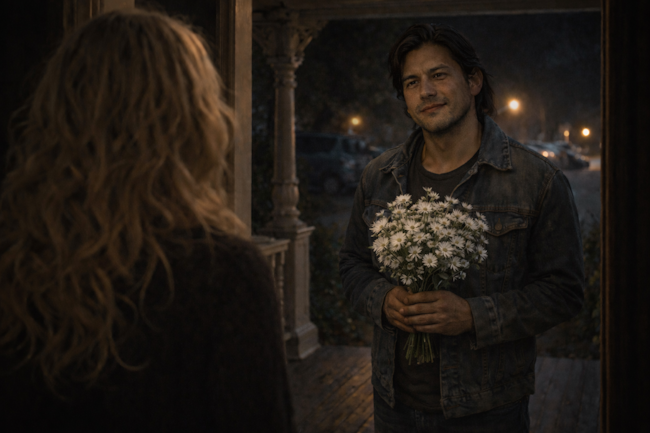
“Hello,” he said quietly.
For a second, neither of them moved.
“What are you doing here?” she asked, though she already knew the answer.
“I heard,” he said. “About Daniel. I thought maybe… I don’t know. I shouldn’t have come this late.”
She should have told him to leave. She felt it immediately — that old ache, that familiar tightening in her chest. They had ended things kindly, years ago. No yelling. No betrayal. Just two people who wanted different things. That almost made it worse.
“You can come in,” she said, stepping aside.
The house seemed to hold its breath as he entered. He glanced around, taking in the quiet, the half-empty wine glass on the table, the newspaper folded just enough to hide the headline.
“You want some tea?” Hannah asked, already moving toward the kitchen.
Danny laughed softly. “I was thinking more like a beer.”
She stopped. Turned to him. “No.”
He raised his hands in surrender. “Okay. Bad joke.”
They stood there, the distance between them heavy with things unsaid. After a moment, Hannah crossed her arms.
“You shouldn’t stay,” she said. “It’s late.”
“I know.” He hesitated. “I just didn’t want you to be alone tonight.”
“I am alone,” she said, sharper than she meant to. “And I need to be.”
Dominick nodded, disappointment flickering across his face. He reached into his jacket pocket, then paused. From behind his back, he produced a small bundle wrapped in brown paper.
“I brought these for you,” he said. “My mom used to say they helped… with grief.”
Hannah stared at them. White flowers. Delicate, unfamiliar. She didn’t recognize them, but something about them made her skin prickle.
“I don’t want them,” she said, though she didn’t move away.
“They’re yours,” he replied gently, pressing them into her hands. His fingers brushed hers — warm, lingering just a second too long.
She stepped back.
“Go home, Dom.”
He did this time. Paused at the door, glanced back once, then left without another word.
Hannah locked the door behind him and leaned against it, the flowers still clutched in her hand. The moonlight crept farther across the floor.
Later, the shower steamed the bathroom until the mirror fogged over. Hannah stood beneath the hot water, eyes closed, letting it run over her shoulders, down her back, washing the night away as best it could. When she finally climbed into bed, the house was silent again.
Outside, the moon climbed higher.
Closer to full.
Hannah’s bedroom was quiet, the house heavy with sleep. Her breathing had slowed, deep and uneven, the rise and fall of her chest softened by exhaustion and grief. The flowers Dom had left rested on the nightstand, pale petals catching the faint glow of the almost-full moon spilling through the window.
Outside, something lingered.
It pressed itself against the shadowed edge of the glass, almost merging with the darkness. Eyes glinting faintly red in the moonlight, it watched every rise and fall of her chest. It did not blink. It did not breathe like a human. Not entirely.
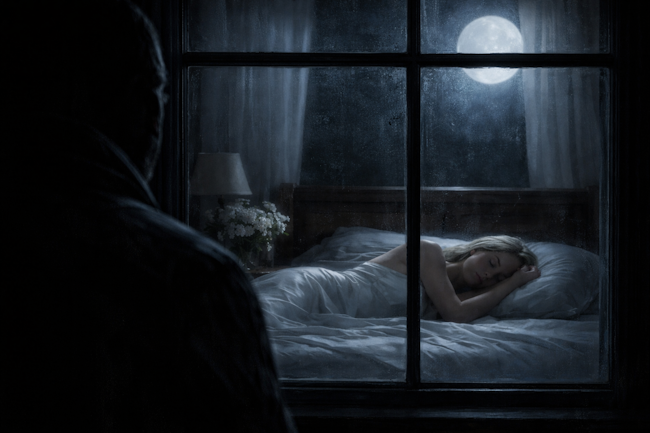
It could smell her. The heat of her skin. The scent of her hair. The faint traces of the wine she had poured hours ago, the taste of salt from tears she hadn’t yet shed.
Its thoughts were not its own — not fully. There was hunger there, but also a strange curiosity, a memory that flickered like a candle in a draft. She is soft. She is warm. She is mine, though she does not know it yet.
A low, unnatural hiss slipped between its teeth, a sound that was almost breathing but not, curling into the quiet like smoke. It tilted its head, watching, calculating, learning the rhythm of her sleep. Every shift of her hand, every twitch of her fingers, every sigh that escaped her lips was noted.
The moonlight stretched across her body, painting pale highlights over her hair, over her shoulders. It studied her like an artist studies a canvas — or a predator studies its prey.
Hannah stirred in her sleep, a soft murmur escaping her lips. The moonlight shifted across her face, brushing her cheek with silver. Something made her shift, a prickle along the back of her neck that felt both familiar and wrong.
Her eyes flicked open. For a heartbeat, she lay still, staring into the darkness beyond her window. At first, she thought it was a trick of the moonlight, the branches casting long, skeletal shadows. But then she caught it — a faint glimmer of red, so subtle it could have been a reflection.
She froze, every muscle taut, her heart hammering behind her ribs. A shadow clung to the edge of the glass, impossibly still. There was a sound too, something almost a breath, wet and uneven, like lungs that didn’t belong to a human. Her body tensed instinctively, but the rational part of her mind whispered it was nothing — just the wind, just her imagination.
Hannah blinked, tried to focus, and the shadow was gone. Only the branches scraped faintly against the window, scratching a rhythm against the cold glass.
She let out a shaky sigh, tucked her knees closer to her chest, and closed her eyes. The warmth of the covers, the monotone tick of the clock, the familiar scent of her bedroom reassured her. Slowly, reluctantly, sleep claimed her again.
Then, without moving closer, without a sound, it receded into the shadows, leaving only the quiet night behind. But its presence lingered in the air, subtle and wrong, like a question whispered in a language she could not understand.
Hannah’s breathing evened. The house returned to its deceptive quiet.
Morning came without mercy.
The sun burned against Hannah’s face, sharp and invasive, cutting straight through the thin curtains. She groaned and rolled onto her side, pulling the blanket up, but it didn’t help. The light found her anyway. It always did. Her head throbbed in dull, uneven pulses, each one reminding her of the wine she never drank and the sleep she didn’t get.
Her mouth felt dry. Bitter.
Hannah sat up slowly, waiting for the room to stop tilting. It didn’t, not right away. There was a heaviness behind her eyes, a pressure that made her squint. When she finally dragged herself into the bathroom and leaned over the sink, she barely recognized the woman staring back at her.
Dark bags hung beneath her eyes. Her skin looked sallow, tight. Her hair was an oily, tangled mess, clinging to her scalp like it hadn’t decided whether it wanted to be alive or dead. She ran the faucet and splashed cold water on her face, hissing softly at the sting.
“I don’t feel like myself,” she muttered to no one.
The phone rang from the other room. Hannah hesitated, then turned the water off and padded back into the living room. She stared at the screen before answering.
“Hey,” she said.
Her sister’s voice was bright, careful. Too careful. “I was thinking lunch today. Somewhere downtown. You shouldn’t be alone.”
Hannah closed her eyes. The thought of sitting in a restaurant, of small talk and clinking silverware and people pretending not to stare, made her stomach churn.
“I can’t,” she said. “I don’t want to eat. I don’t want… that.”
There was a pause. Then, gently, “What about a walk? The park. Just air.”
That sounded better. Movement. Space. Somewhere she didn’t have to talk much.
“Okay,” Hannah said. “A walk.”
She showered quickly, scrubbing her scalp until it burned, letting the water run hot over her shoulders. She pulled on clean clothes and stepped outside, the cold air hitting her like a slap. It helped. A little.
She was halfway down the front steps when she saw him.
Tyler stood near his tow truck, hands on his hips, like he’d been pacing. He looked up when he heard the door, his face easing into something hopeful.
“Hey,” he said. “I was hoping I’d catch you.”
Hannah stopped short. Her chest tightened. “You shouldn’t be here.”
“I just wanted to check on you,” he said, stepping closer. “After last night.”
“I told you I needed space.”
“I know,” he said, frustration creeping into his voice. “But you don’t have to shut me out completely.”
She shook her head. “You can’t do this, Tyler. Not now.”
He exhaled sharply, jaw tightening. “I thought maybe… after everything—”
“No,” she said, firm now. “Please don’t.”
The silence stretched, cold and uncomfortable. Finally, Danny stepped back.
“Right,” he said. “Of course.”
He walked away without another word, his shoulders stiff, his footsteps too loud on the pavement. Hannah watched him go, guilt flickering briefly before being swallowed by exhaustion.
She turned toward the street and started walking, the sun low but relentless, pressing against her skin.
She didn’t notice the way the shadows seemed to cling just a little too long behind her.
The park was quiet
The paths still dusted with patches of frost that hadn’t yet melted under the weak morning sun. Hannah walked beside her sister, pulling her coat tighter around her, letting the cold air sharpen her senses. Conversation came in fragments — small talk, gentle nudges — but Hannah’s mind was elsewhere, still tangled in restless sleep, lingering shadows, and the ache in her chest.
Her sister stopped at a bench, brushing frost off the seat. “You should sit,” she said. “Just for a moment. Look at the lake. It’s—”
“Beautiful,” Hannah murmured, barely hearing her. She kept walking, letting her feet carry her along the winding path lined with bare trees, the branches etching long, skeletal shadows across the frozen ground.
A familiar voice broke the quiet.
“Morning, girls.”
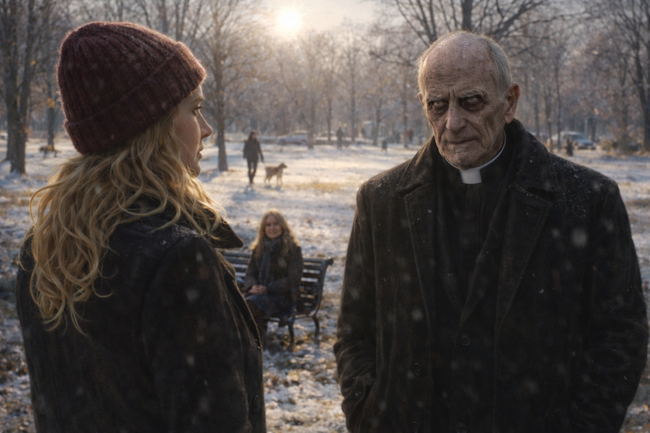
Hannah froze. The priest. Father Callahan. His black coat seemed to absorb the morning light, his face pale and calm, yet the edges of his mouth and eyes carried something… else. Something uneasy.
“Hannah,” he said again, stepping closer, “I was hoping I’d run into you.”
Her sister gave a polite nod and drifted toward the bench, leaving Hannah standing, rigid.
“I’ve had… dreams,” Father Callahan said, his voice low and trembling slightly, as if he were forcing the words out. “Bad dreams. Not for me. For you.”
Hannah tilted her head, unsure if he meant to unsettle her or if he truly believed it. “Bad dreams?” she asked.
“Yes,” he said, leaning slightly closer. “I don’t know what they mean. I… I’m scared, Hannah. God is telling me something, but I don’t understand it. Shadows. Watching. Things that shouldn’t be. I’ve never felt fear like this before… and it’s for you.”
Hannah’s stomach dropped. She forced a laugh, uneasy. “I… I don’t know, Father. I’m fine. Really.”
He shook his head slowly, a frown tugging at his features. “No. You are not fine. Pretending otherwise won’t help. Listen to the dreams, Hannah. They mean something. The world shifts in ways we don’t always see, but you—” He glanced over his shoulder at the park, his gaze sharp, as though he sensed eyes watching them from the shadows. “You need to be ready.”
Hannah swallowed. The cold pressed at her cheeks, but it wasn’t cold that made her shiver. She nodded quickly, unsure what else to do.
“I’ll… think about it,” she said.
Father Callahan gave a solemn nod, then turned and walked away, his steps eerily silent against the frost. The park returned to stillness, but something lingered — a sense of being watched, a weight pressing just beneath the edges of the trees.
Hannah looked at her sister, who had returned with the bench. “Everything okay?” she asked.
“Yeah,” Hannah said softly, but her eyes followed the path where the priest had disappeared.
And she knew, without understanding why, that tonight’s sleep might not be any easier than last night’s.
The night came slowly
Drifting Away
The headlights came quickly. Bright, blinding, slicing through the night. A pickup truck, barreling down the icy road. Her stomach dropped. The brakes screeched in the distance. Her lungs locked. She wanted to scream, wanted to run—but her legs refused.
Not because they were frozen.
Not because she was afraid.
Because they were not hers.
The thought settled into her mind like something already waiting there with devious anticipation. Her body stood perfectly still, planted in the road, as if it belonged to someone else entirely. Her pulse thundered, but the fear wasn’t the loudest thing in her head.
There was something else.
A calm.
A patience.
A knowing that if the truck didn’t stop, if it slid just right on the ice, something would be finished. Something would be satisfied
The thought wasn’t hers. She knew that with a certainty that made her stomach churn. The desire didn’t rise from panic or instinct — it came from somewhere deeper, colder. A place that watched the truck approach and did not flinch.
The tires screamed as the driver fought the wheel, his breath catching when a pair of red eyes locked onto him from the road ahead. The pickup swerved hard, metal groaning, headlights snapping away at the last possible second. Snow exploded into the air as the truck fishtailed past, missing it by inches before spinning into its final destination……….
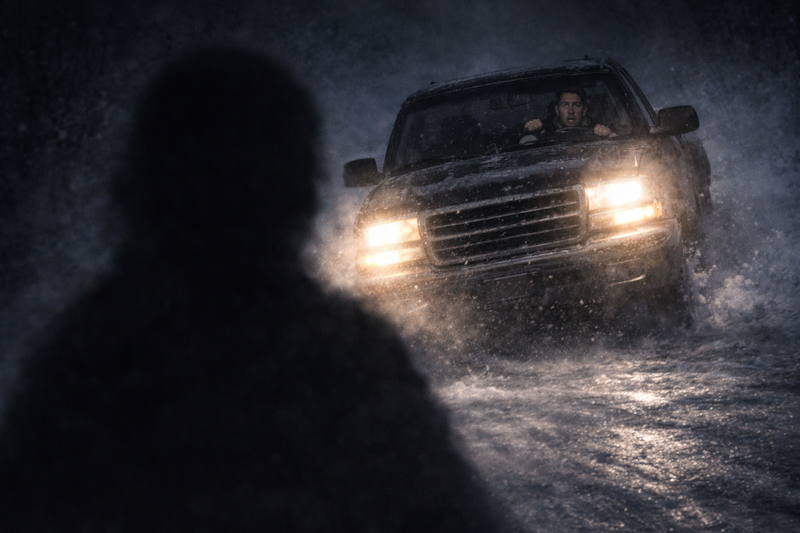
She sat up half aware of her recent nightmare
Gloomy Morning
Hannah sat at the small kitchen table before the morning light fully arrived. Just a thin gray seep through the curtains, the kind that made everything feel unfinished. The chair across from her was empty. It always was now.
Her whole life felt like it had been taken apart piece by piece, long before she was ready. Her parents gone when she was still learning how to be someone. Her sister — the only blood she had left — miles away, busy with a life that included ex-husbands and one problem child. It barely had room for sudden grief. Phone calls, holidays, promises to visit. All of it thin. All of it distant.
Daniel had been the first thing that made the world feel solid.
With him, there was a place to land. A future that felt spoken for. Shared mornings. Shared jokes. Someone who knew how she took her coffee and how she slept with one foot out of the blankets. Someone who made the quiet feel safe instead of loud.
And now even that was gone.
She rested her elbows on the table and covered her face with her hands. The thought crept in slowly, not dramatic, not loud — just tired.
I don’t know if I want to do this anymore.
Not a plan. Not a decision. Just the weight of imagining years stretching forward like an empty road with no landmarks, no promise of warmth. The idea of rest, of stillness, pressed in around her chest. The world felt too big to reenter, too cruel to keep asking things of her.
Her breath hitched. She lowered her hands and stared at the faint reflection of herself in the dark window. Pale. Hollow-eyed. Still here.
For reasons she couldn’t name, she stayed sitting.
The house breathed around her. The clock ticked. Somewhere outside, a car passed. Life, careless and ongoing.
She wasn’t ready to choose anything yet
Just then the phone rang
The phone rang once. Twice. Hannah stared at it from the kitchen counter as if it might ring itself back into silence. When she finally picked it up, her voice came out softer than she expected.
“Hello?”
There was a pause on the line. Then—
“Hannah. It’s me.”
Her breath caught. For just a fraction of a second—an almost cruel, instinctive moment—her heart lifted. Her ears strained. Her spirits surged upward, reaching for something impossible.
Daniel.
The illusion shattered almost immediately, sinking back into her chest like a stone dropped into deep water. It wasn’t him. It was his brother. But the voice—God, the voice—carried the same cadence, the same low warmth at the edges. A genetic echo. Familiar enough to hurt.
She leaned against the counter, eyes closing. At the funeral, he’d stood at a careful distance, flanked by his Madison Avenue wife and their polished, privileged children. Tailored coats. Quiet confidence. Only the occasional glance toward Hannah. A tight smile. Nothing more. They had never accepted her—not really.
He lived on Old Mission Peninsula now. A doctor. Not just practicing—owning. A medical office large enough to employ other doctors. He didn’t even have to work anymore if he didn’t want to. Daniel used to joke about it. Half pride. Half resentment.
“I don’t want you alone,” his brother said. “My wife and the kids—we could come stay a few days. Tonight, even.”
The words landed heavy. Too much. Too soon.
“My sister’s already staying here,” Hannah said quickly. “She just stepped out to pick up her daughter. She’ll be back tonight.”
Another pause. Calculated. Polite.
“Well… then maybe we come by for dinner?”
Hannah swallowed. She wasn’t ready for this. For them. For the quiet judgment in the corners of their eyes, for the way the house would feel smaller with them inside it.
“Dinner would be fine,” she heard herself say. “You’re welcome to come.”
They exchanged a few more careful sentences, all of them distant, and then the line went dead. Hannah lowered the phone slowly, her reflection staring back at her from the darkened window—tired eyes, hollowed cheeks.
The phone rang again almost immediately.
She jumped.
“Hello?”
“Hey,” Tyler said. “I was just checking in. You okay?”
Her answer came faster this time. “Do you want to come over for dinner?”
There was a brief silence—surprised, hopeful.
“Yeah,” he said. “Yeah, I can do that.”
She hung up and stood there for a long moment, the kitchen unnaturally quiet. She wasn’t sure why she’d invited him. Maybe she wasn’t ready to be alone anymore. Maybe she needed noise. Familiar voices. Proof that the world hadn’t completely emptied out around her.
The knock came early.
Hannah was still at the counter, checking the oven, when the sound hit — loud, uneven, already impatient. She didn’t need to look through the peephole to know who it was.
When she opened the door, Tyler stood there grinning, a six-pack dangling from one hand, a loose sway in his shoulders that hadn’t been there the last time she’d seen him.
“Thought I’d bring something useful,” he said, lifting the beer slightly. “You looked like you could use it.”
Her eyes dropped to the bottles. Then back to his face.The look she gave him was sharp, silent — a question and a warning all at once.
Another knock broke the awkward silence
“Hannah,” her sister said gently, stepping forward and pulling her into a tight embrace. “I’m Back”
“Sarah,” Hannah breathed, holding on longer than she meant to.
Behind her, a voice piped up. “Hi, Aunt Hannah.”
Hannah approached her immediately, forcing a smile as she brushed a strand of hair from the girl’s face. “Hi, Mary. You’re getting so big.”
Mary shrugged shyly, clutching her coat sleeves, eyes already roaming the unfamiliar room. Sarah ushered her toward the living room, murmuring reassurances, while Hannah straightened just in time to see Mike step inside.
Daniel’s brother filled the doorway effortlessly. Expensive coat. Confident posture. The kind of man who looked like he belonged anywhere he stood. His wife followed, composed and cool, their children trailing behind like well-dressed accessories. One of them held a handheld game, another asked where the television was without waiting for an answer.“Why don’t you all go play in the den?” Hannah suggested. The kids disappeared down the hallway. Mary followed a step behind.
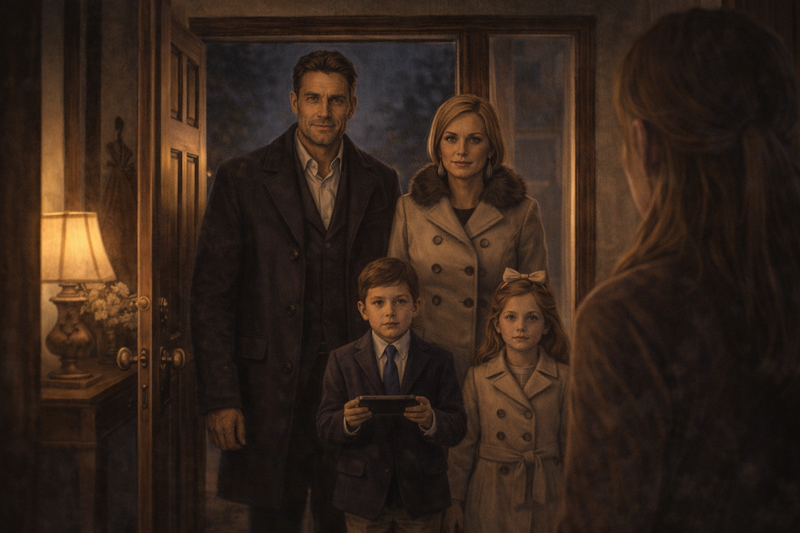
After settling in for a few moments there was another knock at the door, not knowing who it could be, Hannah approaches slowly. Father Callahan stepped inside immediately without invitation, his presence gaining the rooms attention instantly. Do you mind if I join you tonight? Hannah, not wanting to be rude, quickly nods her head.
Conversation eventually resumed and Hannah found herself in the kitchen with the priest as they prepared the last of the meal. He leaned in close, his voice low. “I don’t like him.”
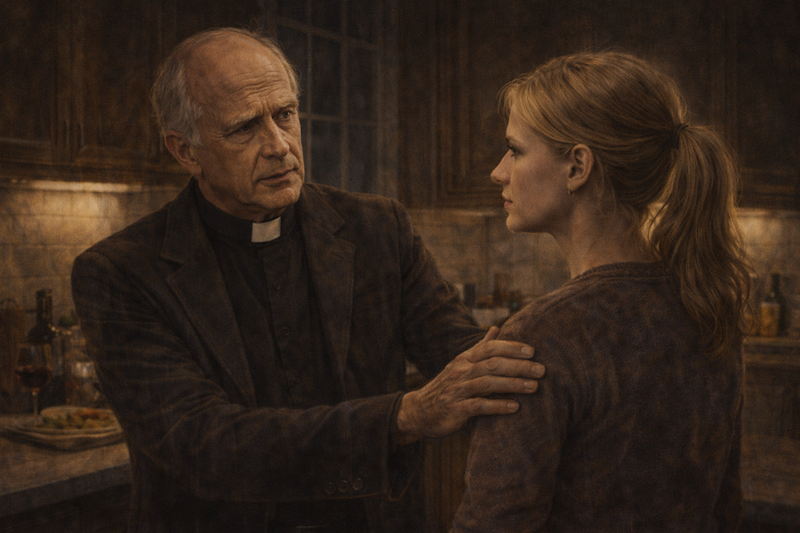
Hannah froze. “Who?”
“Tyler.” His eyes flicked toward the dining room. “There’s something wrong there. I can feel it. I don’t know what it is yet, but you should keep your distance. I’ll figure this out.”
Before she could respond, something caught her attention.
At first, the noise drifting back was harmless — video game sounds, laughter. But as Hannah listened, she caught fragments of conversation.
“She doesn’t know how to play.”
“Don’t touch it like that.”
“My dad said it’s expensive.”
Mary’s voice came quieter. “I was just—”
Then silence.
Hannah turned instinctively, already moving toward the den, but Father Callahan touched her arm gently. “Let me finish this,” he said softly. “I just wanted to speak with you alone for a moment.”
“Aunt Hannah?”
Mary stood in the doorway, eyes bright with unshed tears. Behind her, one of Mike’s children shrugged.
“She broke it,” the boy said flatly.
“I didn’t,” Mary whispered.
Hannah crossed the room immediately, kneeling again. “It’s okay,” she said, louder than necessary. “Go sit with your mom honey.”
Mary nodded and hurried away.
When Hannah looked up, Mike was watching her. His smile was polite. His eyes were not.
Dinner resumed, stiffer now.
Mike spoke easily of living, of the view from his house, of his medical practice — how it had grown, how busy he was, how fortunate. His wife nodded in quiet agreement. Tyler sat too close to Hannah, refilling her wine without asking, brushing her arm.
Tyler took a long pull, watching Hannah over the rim of the bottle, that familiar look slipping into place — “You don’t have to be alone tonight,” Tyler murmured.
She stiffened. “Tyler. Please.”
He smiled like it was a joke.
Mike noticed. His jaw tightened. When Tyler turned his attention to Sarah, leaning in with a compliment that landed wrong, Mike’s expression hardened further.
Sarah laughed awkwardly and stepped back. “I’m married.”
“Lucky man,” Tyler said.
Hanna and Mary both look at each other and wonder if he would believe it.
Midway through the meal, Mike excused himself to the bathroom.
When he returned, he barely spoke. He drank instead. Watched.
A few minutes later Tyler’s phone buzzed.
“Tow call,” he said, already standing.
At the door, Tyler and Mike locked eyes. The look was brief — sharp, loaded.
The door shut.
Mike stood shortly after. “We should go.”
Father Callahan gathered his coat as well. He paused beside Hannah. “Be careful,” he said softly.
The house emptied, leaving toys scattered in the den, plates half-cleared, and Mary asleep on the couch under a blanket too thin for the season.
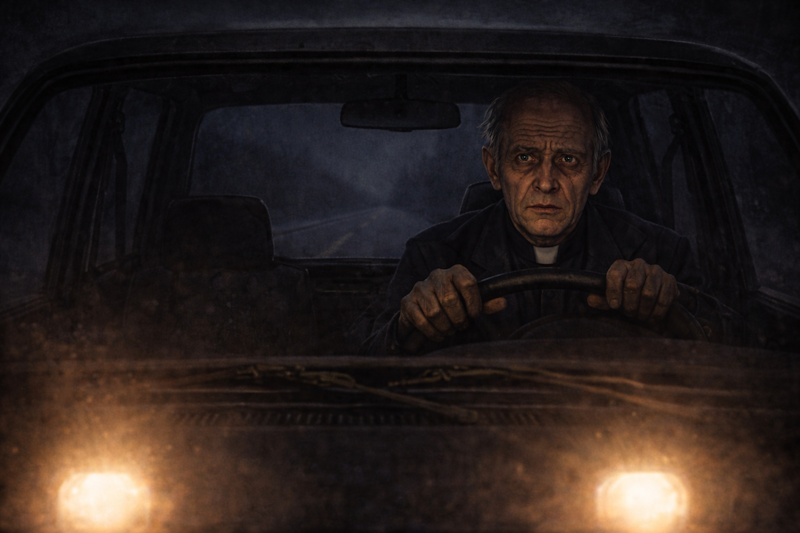
After the dishes were stacked and the house finally went quiet, Hannah led Sarah and Mary down the narrow hallway, the floorboards creaking softly beneath their steps. She showed them the spare bedroom, tucking Mary in while Sarah murmured her thanks, exhaustion etched into her face. When she returned to her own room, the weight of the night settled in all at once. Hannah slipped out of her clothes, crawled beneath the covers, and lay staring at the ceiling as the house breathed around her—full, emptied, and still not at peace—until sleep finally took her.
Outside, night had fully taken hold.
Somewhere in the night people were living normal lives
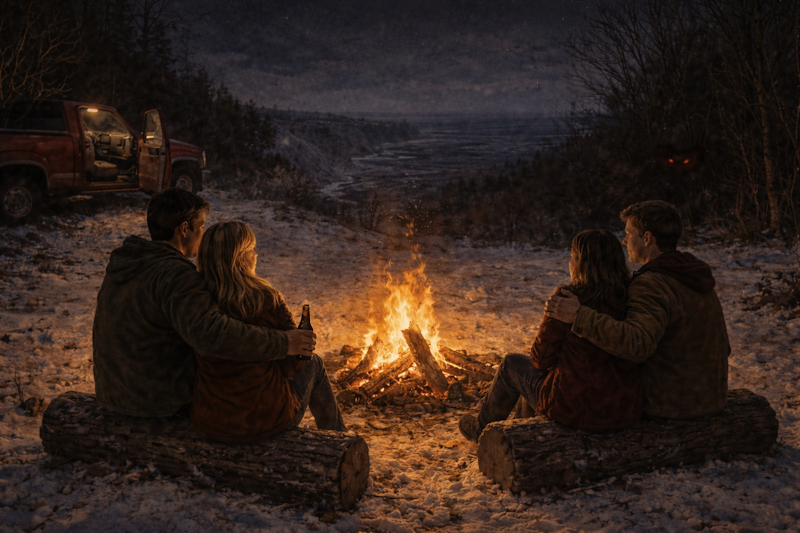
The truck rattled down the narrow county road, headlights carving tunnels through the bare trees. The snow along the shoulders was thin and dirty, more memory than winter—patches of frozen earth showing through where it should have been white. It had been warm for weeks. Too warm. The kind of winter that felt wrong.
Someone cracked open another beer in the cab, laughter spilling out with the cold air as the truck slowed near the bluffs outside of Bulah. The lake below was a black sheet, motionless and watching.
“This is perfect,” one of the guys said. “Nobody comes out here anymore.”
They hauled wood from the bed of the truck, boots crunching on icy leaves. The fire caught quickly, flames snapping and rising, throwing wild shadows across the trees. Music played low from the truck radio. Bottles clinked. The girls leaned into their boyfriends, faces flushed from drink and heat, breath fogging the air.
At first, the sound in the woods was easy to ignore.
A branch snapping.
A rustle too heavy for wind.
One of them paused mid-laugh. “Did you hear that?”
“Probably a deer.”
But the sound came again—closer this time. Slow. Deliberate. Something pacing just beyond the firelight, where the trees thickened and the dark pressed in.
The woods went quiet.
No insects. No wind. Even the fire seemed to hesitate, flames guttering low.
Then came the breathing.
Deep. Wet. Not rushed.
Like something that knew it didn’t have to hurry.
The flashlight beam shook as it swept the tree line, catching nothing but trunks and drifting smoke—until it landed on eyes.
Too high off the ground.
Too far apart.
Reflecting gold.
It stepped forward.
The shape unfolded into the firelight—wrong proportions, shoulders rolling forward, limbs bending where they shouldn’t. Fur matted dark along its body, steaming faintly in the cold air. Its mouth opened, and the sound that came out wasn’t a growl.
It was a scream.
Panic exploded.
Someone tripped. Someone else dropped a bottle that shattered on the rocks. One of the girls ran toward the truck, keys shaking in her hand, crying his name over and over—
The creature moved faster than thought.
The fire was kicked apart. Embers scattered. The woods filled with shouting, then screaming, then sounds that ended too abruptly.
The truck door hung open, headlights still on, engine dead.
By morning, the fire pit was nothing but ash and blackened wood. Beer cans lay crushed in the dirt. The snow around the bluffs was churned and darkened, marked with deep impressions that did not resemble any animal tracks known to the area.
Searchers found what was left scattered among the trees and along the ridge—blood frozen into the ground, torn clothing snagged on branches, pieces of a night that had ended violently and without mercy.
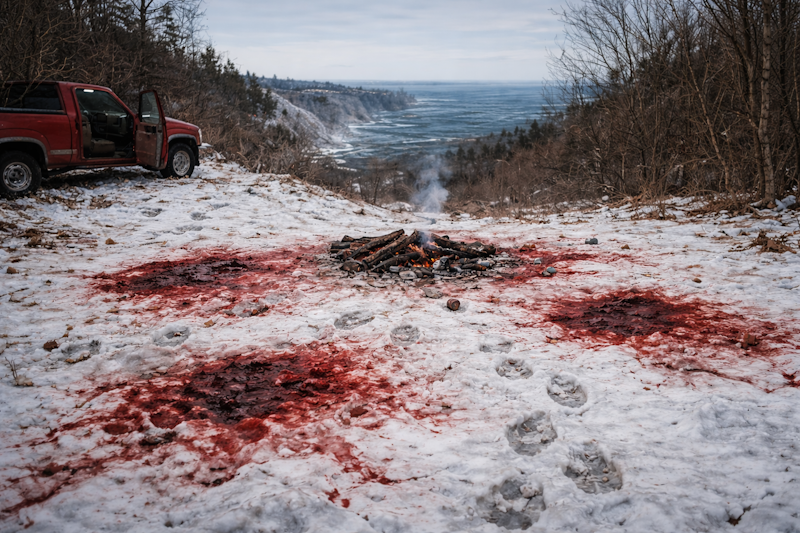
No bodies were recovered intact.
Officials would later say it was an animal attack.
Exposure.
An accident fueled by alcohol and bad judgment.
But locals whispered about the sounds heard from the bluffs that night—howling that didn’t fade with distance, and a scream that carried too long to be human.
And for the rest of that winter, no one went out there after dark.
Traverse City Today
January 1999
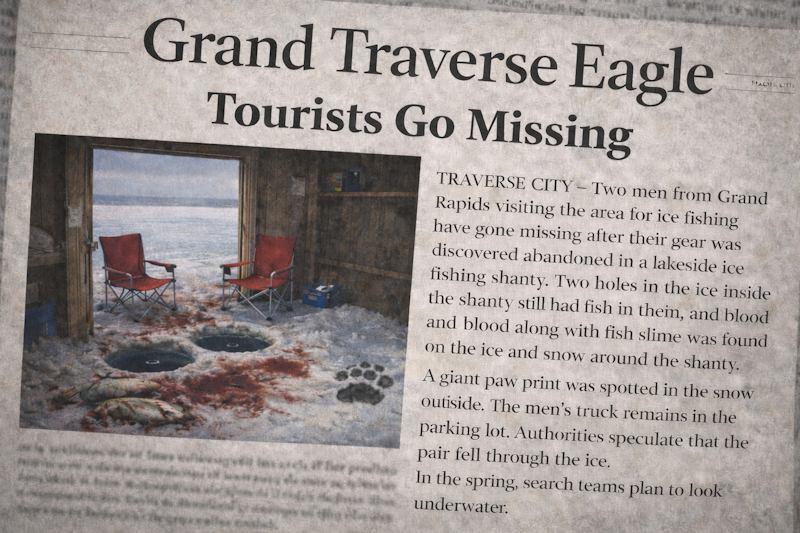
Tow Truck Driver Found Dead Near Winery; Authorities Investigating
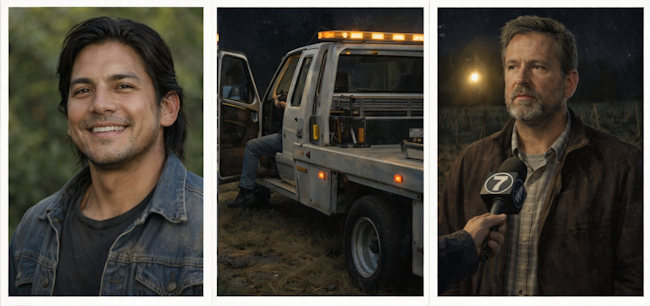
Old Mission Peninsula, MI — Authorities are investigating the death of a local tow truck driver whose body was discovered late Tuesday night on the grounds of a former cherry orchard that has since been converted into a winery and grape field on the Peninsula.

The victim, Tyler Rivers was found near the edge of the vineyard shortly after 11:30 p.m. by a winery employee returning to the property. According to the Grand Traverse County Sheriff’s Office, Tyler was pronounced dead at the scene.

Investigators say Tyler appeared to have suffered a fatal slash wound to the throat. A map was reportedly clutched in his hand when deputies arrived, though officials have not yet commented on its significance or where it may have been leading him. There were no immediate signs of a struggle beyond the immediate area, and no witnesses have come forward. Deputies secured the property overnight as crime scene technicians processed the area, searching for forensic evidence among the rows of dormant vines and frozen ground.

Tyler was well known in the community through his work as a tow truck driver, often responding to late-night calls along rural roads throughout the peninsula. Officials confirmed he had been dispatched earlier in the evening but did not arrive at his destination.

At this time, investigators say there is no suspect in custody. Authorities are asking anyone who may have seen Tyler’s tow truck in the area or noticed unusual activity near the winery Tuesday night to contact the Grand Traverse County Sheriff’s Office.

“This is an active and ongoing investigation,” officials said in a statement. “We are following multiple leads and urge the public not to speculate as we work to determine exactly what happened.”

The winery has temporarily closed portions of its property while the investigation continues.
Copyright 1999 Traverse City Today
Hannah woke already nauseous.
It wasn’t the sharp kind that came and went. It was heavier than that—deep, radiating outward from her stomach like something had settled there overnight and refused to move. She lay still for a moment, eyes closed, hoping it would pass.
It didn’t.
She barely made it to the bathroom before retching, one hand braced against the sink, the other clutching her abdomen. When it finally subsided, she stayed there, breathing hard, forehead resting against the cool porcelain.
By the time she reached the kitchen, she looked hollowed out.
Her sister was already there, seated at the table with a mug of coffee cradled between her hands. She looked up immediately.
“Hannah… you okay?”
Hannah sank into the chair across from her. “No,” she said quietly. “I don’t think so.”
Her sister waited.
“It’s every morning now,” Hannah continued. “Not just today. I wake up and it’s like… it’s already there. Like it’s been waiting for me.” She pressed her palm to her stomach. “This morning I actually threw up.”
Her sister’s expression shifted—concern sharpening into focus. “Have you been eating?”
“That’s the thing. I can’t. And my chest hurts.” Hannah hesitated, embarrassed despite herself. “Not sore. Just… swollen. Tender.”
Her sister didn’t respond right away. She studied Hannah’s face, the dark shadows beneath her eyes, the way she held herself slightly forward, protective.
“When was your last period?” she asked gently.
Hannah frowned. “I don’t know. I’ve never been regular. Sometimes I skip months.”
The kitchen went quiet. The refrigerator hummed. Somewhere in the house, a pipe clicked.
“Hannah,” her sister said carefully, “you might be pregnant.”
The word sat between them.
Pregnant.
Hannah’s first reaction was panic. Immediate and visceral. Her chest tightened, breath catching as a hundred impossible thoughts crowded in at once. And then—unbidden, unwelcome, undeniable—came something else.
Daniel.
A piece of him.
She swallowed hard. “I can’t even think about that right now.”
Her sister reached across the table and squeezed her hand. “You don’t have to decide anything. Just… maybe find out.”
The drive to the store felt surreal. The roads were familiar, but everything looked slightly wrong, as if she were seeing the town through a warped lens. Her hands gripped the steering wheel too tightly.
If it was positive, she thought.
If it wasn’t.
She imagined holding something small. Imagined Daniel’s face in it. Imagined the ache easing just a little.
Then she imagined doing it alone.
The store lights were harsh, unforgiving. She moved slowly through the aisles, her head swimming, until she heard her name.
“Hannah?”
She turned.
A woman from town—someone she recognized but didn’t know well—stood a few feet away, eyes bright with the wrong kind of energy.
“Did you hear about Tyler?” the woman asked.
Hannah’s stomach dropped. “Hear what?”
“They found him this morning,” the woman said, lowering her voice. “Dead. In his tow truck.”
The words didn’t register at first.
“No,” Hannah said automatically. “That’s not—”
“It’s in the paper,” the woman interrupted, nodding toward the rack by the entrance.
Hannah walked to it without remembering deciding to. Her fingers trembled as she unfolded the paper.
TRAVERSE CITY EAGLE
Tow Truck Driver Found Dead Near Winery
The store tilted violently. The edges of her vision started to darken.
Tyler’s face stared back at her.
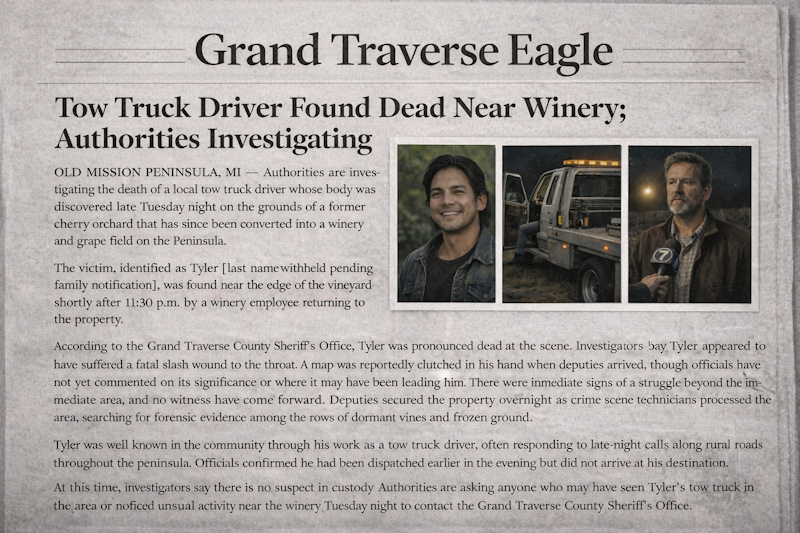
She dropped the paper.
Someone said her name again, but the sound felt distant. She turned and staggered outside, the bell over the door ringing sharply behind her. Cold air hit her lungs. Her knees buckled.
She collapsed onto the cold pavement.
—
Lights.
Hannah opened her eyes slowly, pain exploding behind them. She groaned, instinctively lifting a hand to her head.
“Hannah.”
Mike’s voice cut through the haze.
She turned toward him. He stood beside the hospital bed, coat neatly draped over one arm, expression carefully neutral.
“You fainted,” he said. “Hit your head. You’re lucky.”
“What… what happened?” she whispered.
“You were brought in by ambulance.”
Tyler. The paper. The headline.
“What happened to him?” she asked suddenly. “Tyler.”
Mike blinked once. “I don’t know. I’ve been in the office all day. I only came down when I heard you were here.”
Her stomach churned again. “Mike… I think I might be pregnant.”
The air changed.
Mike’s jaw tightened. His posture stiffened. He turned sharply and walked toward the door. “Nurse.”
A nurse appeared moments later. “We’ll run a test,” she said kindly.
When she returned, Hannah barely heard the words. The room spun violently. She turned her head just in time to vomit again. Her head throbbed. God, how it hurt.
The doctor came in later, chart in hand, voice distant and clinical. “So, you are pregnant,” he said.
Hannah stared at him, the words echoing strangely.
“I’ll help you through this,” he continued. “Given the circumstances… it’s important.”
“Circumstances?” Hannah asked faintly. He didn’t answer.
Her sister still wasn’t there.
Hannah asked for her. No one had seen her. She called the house. No answer. Paged her. Nothing.
When they finally released her, she walked home alone, every step heavy.
Slipped in the crack of the door was a business card from the Grand Traverse Sheriffs Department along with the name of a detective she was familiar with.
The house was dark.
The beep of the answering machine cut sharp and sudden in the quiet house. Hannah froze in the entryway, keys still in her hand, her eyes drifted back to the business card taped crookedly to the door. Grand Traverse Sheriff’s Department. The name printed beneath the badge number makes her stomach tighten. She recognizes it.
The house felt different when Hannah stepped inside. She set her keys down slowly and stood in the entryway, listening. Nothing.
“Sarah?” she called, even though she knew better.
The coat rack by the door was missing one jacket. The spare bathroom sink was dry, toothbrush gone. The couch pillows had been straightened too neatly, like someone trying not to leave a trace. Her sister had packed. Hannah opened the guest room. The bed was made. The blanket folded at the foot the way her sister always did when she was preparing to leave — not staying.
A note sat on the dresser:
Hannah, Not sure when you are going to be home. Mary is getting bored- Talk soon, Love Sarah
That was it. No apology. No explanation. No promise of return.
Hannah sat on the edge of the bed and stared at the wall for a long time. She didn’t cry. Not yet. This hurt wasn’t new enough to demand tears. It was older than that. Deeper.
Her sister never stayed.
Not when their parents died. Not when things got heavy. Not when Hannah needed her the most. She always left just early enough to pretend it wasn’t abandonment. Just late enough to make it hurt.
“I needed you,” Hannah whispered to the empty room.
“Beep” The sound of the answering machine pierces the silence again. She walks over and presses the button with a trembling finger. A man’s voice fills the room—calm, practiced, official. “Mrs. Harper, this is Detective Paul Reeves with the Grand Traverse County Sheriff’s Department. I’m trying to reach you regarding the murder of Tyler.” There’s a pause, the faint sound of paper shifting on the other end. “Please contact me as soon as possible. We have a few questions, and your name came up.” The machine clicks off, returning the house to silence.
Hannah doesn’t move. The word murder echoes louder than it should. Tyler isn’t just gone—he’s been murdered. And somehow, impossibly, she’s part of it now.
She pressed her hand to her stomach, not knowing whether it was comfort or instinct. The house creaked around her, settling into itself like it had already accepted the absence.
She will make the call in the morning.
She turned off the lights one by one as the house grew darker, the weight of the night settling in again. Outside, the street was quiet.
Detective
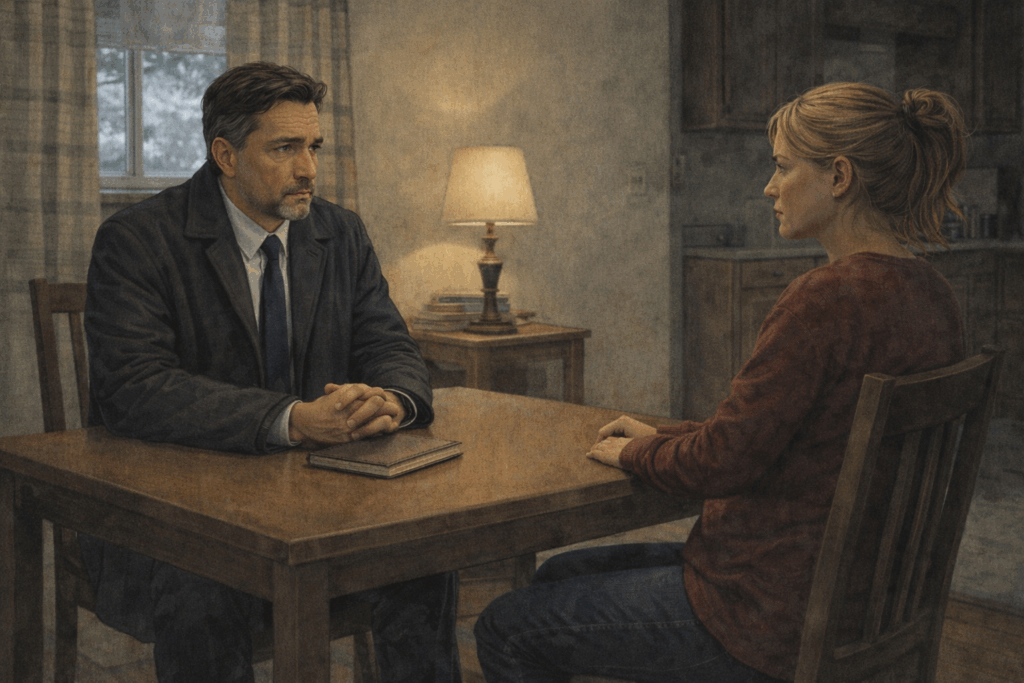
Detective Reeves sat across from Hannah at the small dining table, his notebook closed for now, his posture careful. Not relaxed, exactly—but not aggressive either. The kind of stance meant to put someone at ease without pretending the situation was normal.
“I want you to understand something,” he said gently. “You’re not a suspect. Not even close.”
Hannah nodded, though her hands were still folded tight in her lap, knuckles pale. The house felt too quiet with someone else in it. Every sound—the tick of the clock, the distant hum of the refrigerator—felt amplified.
“I just need you to walk me through that night,” Reeves continued. “The dinner. Who was there. Anything that stood out.”
She swallowed. “It was… normal. As normal as it could be, given everything.”
She paused, searching for the right words. “Family. A few people from town. We ate. Talked. Nothing felt violent. Nothing like that.”
“Anyone upset?” Reeves asked. “Arguments? Tension?”
Hannah hesitated. Not long—but long enough to notice.
“There was tension,” she admitted. “But not with Tyler. He didn’t argue with anyone. He was… himself. Too charming, maybe. Too familiar. But not angry.”
Reeves watched her closely now. “Did anyone seem uncomfortable around him?”
Her eyes drifted, almost involuntarily, toward the kitchen doorway.
She shook her head. “I don’t know. People feel things sometimes. Vibes. That doesn’t mean anything.”
“Sometimes it does,” Reeves said evenly. “I’m not asking you to accuse anyone. I just need to know if something felt off.”
Hannah exhaled slowly. “There was a moment,” she said. “In the kitchen. I was talking with Father Callahan.”
Reeves’ pen paused midair.
“He said he’d been having bad dreams,” she continued. “That he felt… unsettled. About Tyler. He didn’t explain why. Just said I should be careful.”
“And how did that strike you at the time?” Reeves asked.
“At the time?” She gave a small, humorless smile. “Like concern. Like he was trying to protect me.”
“And now?”
Now, the words didn’t come so easily.
Now she remembered the way his hand had lingered on her arm. Not inappropriate—just longer than necessary. The way his eyes had flicked toward the dining room, sharp and assessing. The way his voice had dropped, almost reverent, when he spoke about things he didn’t understand.
“I don’t know,” she said finally. “I keep replaying it. Wondering why he felt the need to say anything at all.”
Reeves nodded slowly, jotting something down. “Anyone else mention Tyler that night? Anything strange?”
“No,” Hannah said, but the word felt thin. “Not out loud.”
Reeves closed his notebook. “Okay. That’s all for now. If you remember anything else—even something that feels insignificant—call me.”
He stood, then hesitated. “Grief does strange things. It sharpens instincts. Don’t ignore yours.”
After he left, Hannah remained at the table long after the door closed behind him.
Her eyes drifted again to the kitchen.
To the place where concern had felt like comfort.
And where, now, it felt like something else entirely
The Call
The funeral
Hannah spent the rest of the day on the couch, the curtains half drawn, the house dim and still. Time moved without meaning. The clock on the wall ticked, but she didn’t check it.
When the phone rang, the sound startled her.
She stared at it for a moment before answering. “Hello?”
“Hannah,” a woman’s voice said softly. Familiar. Warm. “It’s me” said Tyler’s mom
Something in Hannah’s chest loosened instantly. She sat up, pulling the blanket tighter around herself. “Hi.”
“I hope I’m not calling too late,” she said. “I just… I wanted to talk to you.”
They had always liked each other. From the beginning. Tyler’s mother had never treated her like an obligation or an extension of him — just Hannah. Someone worth knowing on her own.
“I wanted to ask if you’d come to the funeral,” she continued. “It would mean a lot. And… it would be good to see you again. To catch up.”
Hannah hesitated. “I don’t want to intrude.”
“You wouldn’t be,” she said immediately. “Aaron keeps asking about you. He wants to know how you’re holding up. We all do.”
There was a pause on the line, then her voice softened further. “And Hannah… I need to talk to you about something. Something important.”
Hannah swallowed. Her heart picked up speed. “Okay.”
I have to talk to you about something too, she stared at the wall as the words came out, fragile but honest. “I’m pregnant.”
The silence that followed wasn’t shock. It was calm.
“Oh, Hannah,” Tyler’s mom said gently. “That’s a lot to carry at once.”
“I didn’t know who to tell,” Hannah admitted. “Everything feels like it’s falling apart.”
“It isn’t,” she said firmly. “It feels that way because you’re standing at the beginning of something new, not the end.” She paused. “You’re strong. Stronger than you think. And now you have someone who needs you to be.”
Hannah closed her eyes, tears pricking for the first time all day.
“You take care of yourself,” she continued. “Body and mind. Eat well. Rest when you can. A healthy mother makes for a strong child. And you’re not alone — even if it feels like it.”
They talked a little longer after that. About small things. About weather. About memories that didn’t hurt as much as Hannah expected.
When the call ended, the house didn’t feel quite so empty.
Hannah set the phone down and sat there for a while, breathing more easily than she had all day. The heaviness was still there — grief didn’t disappear — but it no longer felt like it would crush her.
Tyler’s mom had always had a way of doing that.
Making the world make sense again.
Hannah let the receiver settle back into its cradle, the soft click echoing louder than it should have in the quiet house. For a moment she didn’t move. She stood there with her hand still resting on the phone, breathing in, breathing out, letting the warmth of Tyler’s mother’s words sink in. You’re strong. You always have been. It was the kind of reassurance that didn’t try to fix anything—just steadied you enough to keep going.
She crossed the living room slowly and sank onto the edge of the couch. Outside, the afternoon light sat pale and unmoving on the snow, as if the day itself had stalled. Hannah leaned back and closed her eyes.
Aaron Rivers drifted into her thoughts without effort.
He’d been younger than Tyler by a few years—gangly at first, all elbows and quiet smiles. Wherever Tyler went, Aaron wasn’t far behind. At bonfires, at the lake, hanging around the edges of conversations he was too shy to join. Hannah used to tease him about it. You know you don’t have to follow us everywhere, right? He’d just grin and shrug, unbothered, content just to be nearby.
He’d always been gentler than Tyler. Less restless. Where Tyler filled a room, Aaron observed it. He listened more than he spoke, and when he did talk, it was usually to ask how someone else was doing. He remembered small things—how Hannah took her coffee, which songs she liked on the radio. Once, after Tyler snapped at her during an argument, Aaron had lingered behind, awkward and sincere, to apologize for his brother like it was somehow his responsibility.
Tyler had looked out for him, too. That much had always been obvious. Even when they teased each other or butted heads, there was an unspoken understanding between them. Tyler stood a little closer when Aaron was around. Watched the room more carefully. Hannah had seen it a hundred times—the subtle shift, the protective edge. Whatever else Tyler was, he’d been a good brother.
The thought tightened something in her chest.
Aaron had looked at her once, years ago, with that open, earnest admiration that made her laugh and feel a little sad at the same time. Like a puppy dog, she’d thought then—devoted, hopeful, always trailing behind. But he’d grown into himself eventually. Quieter still, but steadier. Kinder.
Hannah opened her eyes and stared at the ceiling. Somewhere, Aaron was grieving his brother now. Somewhere, Tyler’s mother was holding herself together with the same quiet strength she’d just offered over the phone.
The weight of it all pressed down—but beneath it was something steadier. A sense of connection. Of being held, even at a distance, by people who remembered her not just as what happened, but as who she was.
Tyler’s mom had been right. She always had a way of making things make sense.
Hannah drew a slow breath, rested a hand lightly over her stomach without quite realizing she’d done it, and let herself sit with the memory a moment longer—of two brothers, of loyalty, of a younger boy who’d always been kinder than anyone gave him credit for.
Getting Ready
The first strange thing happened while Hannah was buttoning her coat.
Her hands paused at her stomach, fingers splayed just below her ribs. For a moment, she thought it was nausea again — the familiar churn, the warning heat behind her throat. But this was different. Deeper. Centered.
A pressure.
Not pain. Not movement. Just the unmistakable sensation of something settling, as if her body were making room without asking her permission.
She stood very still in the bedroom, listening to her own breathing. The house creaked softly around her. After a few seconds, the feeling faded, leaving behind a chill that had nothing to do with the winter air leaking through the window.
“You’re just nervous,” she murmured to herself.
She finished getting dressed slowly. Black wool coat. Gloves. Sensible shoes for snow. She brushed her hair back, studying her reflection longer than necessary. Her face looked thinner. Paler. Her eyes felt older.
In the bathroom, she hesitated before the mirror again, one hand resting lightly on her stomach.
“I’m doing this,” she said quietly. “I’m okay.”
The drive north felt longer than it should have.
The roads were clear but narrow, flanked by snowbanks and bare trees that reached toward the sky like skeletal fingers. The radio murmured low voices and static, a local station talking about weather and road conditions. Hannah turned it off.
The silence suited her better.
As the miles passed, she felt that pressure again — brief, almost curious — then gone. Her grip tightened on the steering wheel. She focused on the road, on the rhythm of tires over pavement, on the way the bay flashed silver through the trees.
Suttons Bay appeared suddenly, familiar and small. The church stood just off the main road, white against the snow, modest and unassuming. Cars lined the street. Too many.
This was only the first part.
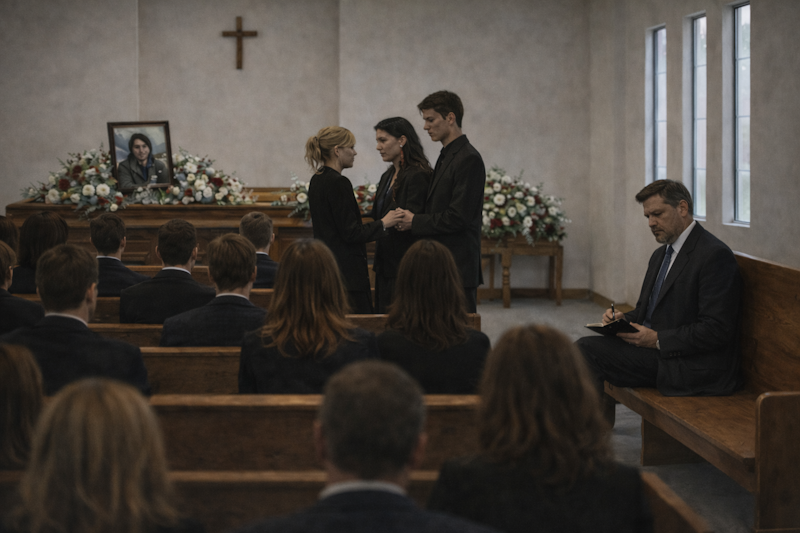
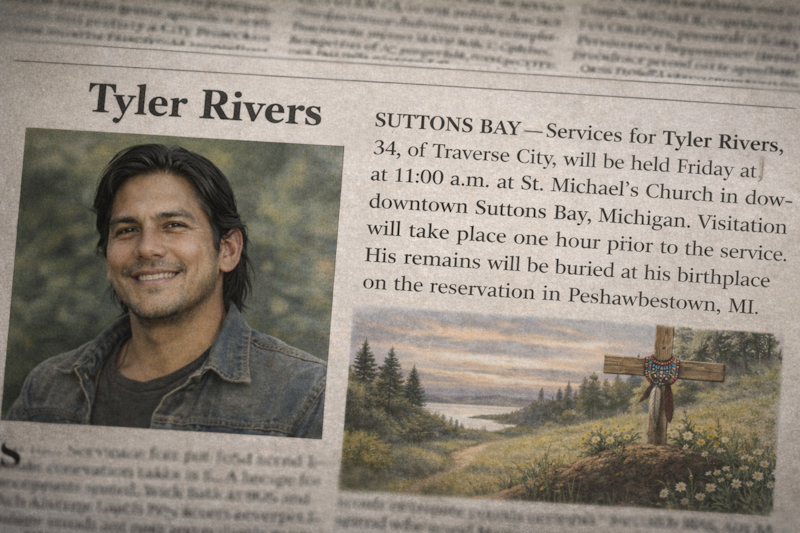
The service here was for the town — for coworkers, friends, and those who needed pews and hymns and something familiar to hold onto. Afterward, Tyler’s family would travel south again, to the reservation, where he would be laid to rest properly. Where the burial would take place among his people, on land that knew his name.
Hannah parked and sat for a moment, breathing, watching people move toward the entrance in dark coats and scarves. Native families. Friends. Strangers. She recognized faces she hadn’t seen in years.
As she stepped out of the car, the cold bit sharply at her lungs.
She pulled her coat tighter and started toward the church — and that’s when she saw him.
Detective Reeves stood near the edge of the lot, speaking quietly with a man she didn’t recognize. He wasn’t in uniform. Just a dark coat, hands in his pockets, posture relaxed but alert. He wasn’t watching the church.
He was watching the people going in.
Their eyes met briefly.
There was no surprise on his face. Just recognition. A small nod. Professional. Respectful.
Hannah’s stomach tightened again — not the strange pressure this time, but something sharper. Awareness.
He didn’t come to mourn, she thought. He came to observe.
She looked away and continued toward the doors, the sound of voices swelling around her. As she stepped inside, warmth and the scent of burning sage wrapped around her, grounding her just enough to keep moving.
Behind her, the door closed.
And outside, the detective remained where he was, watching the first service begin — knowing the second would come later, far from town, where fewer eyes would be watching.
Peshawbestown

The second service was quieter.
There were no pews this time, no polished wood or echoing hymns. Just the open land of the reservation, snow pressed flat beneath many boots, the sky low and pale like it was holding its breath. Smoke from the ceremonial fire drifted upward in slow, deliberate curls, carrying with it the scent of cedar and something older—something that felt like memory itself.
Tyler’s ashes rested in a simple vessel near the center of the gathering. No glass. No shine. Just something honest, surrounded by offerings: tobacco ties, beads, folded cloth, and white flowers laid gently at its base.
Hannah stood near the edge at first, her coat pulled tight, the cold biting sharper here than it had at the church. This was different. More intimate. Harder. It felt like stepping into a space that didn’t belong to her—and yet, somehow, she had been invited.
She thought back to earlier that day, to the space between the two services—the church emptied, coats being gathered, the slow, awkward pause before everyone went their separate ways. Detective Reeves had approached her then, near the steps, his voice careful.
“I’m headed out toward the reservation,” he’d said. “I can give you a ride, if you’d like.”
She’d shaken her head immediately. “Thank you. I need the drive.”
He hadn’t pressed. Just nodded, understanding written plainly across his face. “All right,” he’d said. “Drive safe.”
Now, seeing him again at the second service, standing a respectful distance away, no notebook in sight, she was grateful she’d chosen to come alone. The road between the church and the reservation had given her time—too much time, maybe—but also the space to steady herself.
The ceremony ended without fanfare. No rush. Just people shifting, murmured words, the fire crackling softly as the wind moved through the bare trees.
Her breath caught, and before she could stop it, tears slipped free.
Aaron was there almost instantly.
He didn’t speak right away. He just stood beside her, close enough that she could feel his presence, solid and grounding. The boy who had once followed her everywhere was gone—this was Tyler’s brother now, quieter, stronger, carrying his grief without letting it spill.
“He always came back here,” Aaron said finally, eyes fixed on the fire. “No matter how far he went.”
Hannah nodded. “He said it made things feel… right.”
Aaron gave a small, sad smile. “Yeah. That’s true.”
They stood together, watching the smoke rise.
Then Angel found her.
Tyler’s mother moved through the gathering with calm purpose. When she reached Hannah, she took her hands and pressed something into them without explanation.
White flowers.
The same kind Tyler used to leave. The ones Hannah already knew—their scent faint but unmistakable. Familiar. Intentional. Along with them, a small packet of seeds, carefully wrapped.
“Keep the flowers by your bed,” Angel said quietly. “They’re meant to watch over you.” She closed Hannah’s fingers around the seeds. “Plant these in the spring. Near your home. They’ve been in our family a long time.”
Hannah’s throat tightened. “I will.”
Angel’s gaze softened. “They’re for protection,” she said. “For strength. You’ll need both.”
She pulled Hannah into a brief embrace, firm and grounding. “You’re not walking this alone,” Angel added. “Not anymore.”
As the gathering slowly thinned and the fire burned lower, Hannah stood holding the flowers against her coat. The land felt vast, ancient, and watchful beneath the snow.
And though her grief remained—heavy and undeniable—something else settled alongside it.
A sense of being seen.
And, somehow, kept.
Hannah hadn’t planned on seeing Angel again so soon.
It started small—calls at first. Angel checking in the way only someone who had lived through real loss could. No empty reassurances. No pressure to be okay. Just questions that didn’t demand answers.
Did you eat today?
How did you sleep?
Are the flowers still with you?
Hannah found herself answering honestly. More honestly than she had with anyone since Daniel died.
A few days later, Angel stopped by with soup and a loaf of warm bread wrapped in a towel. She didn’t stay long. She didn’t pry. She set the food on the counter, touched Hannah’s arm once—firm, grounding—and told her she’d call again soon.
And she did.
Through Angel came Aaron.
At first, he was just… present. Picking up groceries Angel didn’t want to drive for. Dropping off firewood without knocking. Fixing the loose hinge on the back door without being asked. He never stayed long. Never imposed. He stood with his hands in his pockets, shoulders slightly hunched like he was careful not to take up too much space.
Hannah noticed how easy it was to talk to him.
He didn’t ask about the accident. Didn’t bring up Tyler unless she did. He listened the way people rarely did—without waiting for his turn to speak. Sometimes they sat at the kitchen table drinking tea in silence, the quiet comfortable instead of heavy.
Once, when the nausea had hit her hard enough that she had to sit down on the front steps, Aaron hadn’t panicked. He’d just crouched beside her, offered water, waited until the wave passed.
“You don’t have to explain,” he’d said.
Something in her had loosened then.
It was after one of Angel’s longer calls—after she’d mentioned the house feeling too big at night—that Hannah realized she didn’t want to be alone that evening.
Hannah didn’t mean to call Aaron.
She stood in the kitchen with the receiver in her hand, the cord stretched across the counter, staring at the white flowers Angel had given her—still in the same glass of water where she’d set them after the service. Their petals hadn’t browned. They looked freshly cut, stubbornly alive.
The house had been too quiet for too many days.
When the line clicked and Aaron’s voice came through—soft, careful—Hannah felt something in her chest loosen.
“Hello?”
“It’s Hannah,” she said, and heard the tremor she couldn’t quite hide. “I—sorry. I didn’t know if it was too late.”
“No,” he answered immediately. “No, it’s not too late.”
There was a pause. She could hear muffled movement on his end, maybe a door closing, like he’d stepped away from someone else to give her privacy.
“How are you holding up?” he asked.
Hannah stared at the window over the sink. Outside, the yard was dull with slush and twilight. “Not great,” she admitted. “I keep thinking I’m okay and then I’m not. And I… I don’t want to be in this house tonight.”
Another pause, then his voice gentled further. “Do you want me to come over?”
She surprised herself by saying yes.
Aaron arrived twenty minutes later, shoulders dusted with snow, hair damp at the ends from the wind off the bay. He held a paper bag in one hand and a bundle of firewood in the other like it was nothing. He didn’t knock loudly—just a soft rap, then waited.
When Hannah opened the door, he gave her a small, uncertain smile.
“I brought dinner,” he said, lifting the bag. “Or… ingredients. I didn’t know what you had.”
Hannah blinked. The normalcy of it—someone showing up with groceries like grief didn’t make the world unusable—hit her so hard she almost laughed.
“You didn’t have to—”
“I wanted to,” he said simply, and stepped inside.
The house felt different the moment he crossed the threshold. Not fixed. Not happy. Just… less hollow.
Aaron set the bag on the counter and glanced around like he was trying not to intrude. His eyes paused briefly on the flowers in the glass.
“Mom’s,” Hannah said before he could ask.
He nodded once, expression flickering—something like gratitude, something like pain.
“She worries,” he said quietly.
“I know.” Hannah cleared her throat. “I’m… glad she called me.”
He didn’t answer right away. He pulled off his coat, hung it neatly, and rolled his sleeves up like it was automatic.
“What do you feel like?” he asked. “Soup? Pasta? Something easy?”
Hannah hesitated. She hadn’t had an appetite in days, but the thought of food that wasn’t from a box—food made by someone who wasn’t looking at her like she might break—made her stomach soften.
“Soup,” she said. “If that’s okay.”
“Yeah,” Aaron replied. “That’s perfect.”
They moved around the kitchen together with an ease that surprised her. Aaron didn’t fill the silence with forced conversation. He didn’t ask the wrong questions. He just chopped vegetables with steady hands, set a pot on the stove, found the bowls without rummaging through her cabinets like a stranger.
At one point, Hannah realized she was sitting at the table watching him without meaning to.
“You don’t have to do all of it,” she said quietly.
Aaron looked up, his expression mild. “I don’t mind.”
And then, after a beat, he added, “It feels better to do something.”
Hannah swallowed. “Yeah,” she whispered. “It does.”
When the soup simmered, Aaron built a small fire in the living room. The house took on that slow, warm smell of burning wood, the kind that made winter feel like it belonged. They ate on the couch with the TV off, the only sounds the crackle of the fireplace and the occasional soft clink of spoon to bowl.
Afterward, Hannah found herself talking. Not about the accident. Not the nightmares. Not yet. Just small things—Tyler as a kid, the way he used to steal fries off everyone’s plate, the time he tried to fix a snowmobile and nearly set the garage on fire.
Aaron laughed once—quietly, surprised by it—and then went still.
“I keep forgetting I’m allowed to laugh,” he admitted.
Hannah’s eyes stung. “Me too.”
The silence that followed wasn’t awkward. It was shared.
Comforting.
Time passed strangely. The fire sank lower. The clock moved without Hannah watching it.
And then she said it before she could overthink it.
“You could stay,” she told him. “Tonight.”
Aaron looked up.
Hannah’s hands tightened around her mug. “I don’t mean— I just mean… I’d feel better if you were here. I don’t want to be alone.”
His throat bobbed as he swallowed. He didn’t smile—he looked relieved, like she’d offered him something he hadn’t known he needed too.
“Okay,” he said quietly. “If you’re sure.”
“I’m sure.”
They made up the spare bed with fresh sheets. Hannah gave him a pillow and an extra blanket, then lingered awkwardly in the doorway like she wasn’t used to having someone else in her house anymore.
Aaron stood by the bed, hands at his sides, looking almost embarrassed by how simple this was.
“Thank you,” he said.
Hannah nodded. “Thank you for coming.”
He hesitated, then added, softer, “I’m glad you called.”
Hannah turned to go—then the phone rang.
The sound cut through the house too sharply. Hannah froze in the hall.
Aaron’s gaze lifted, alert in a way that didn’t match the moment. Not fear—something more controlled.
Hannah picked up the receiver. “Hello?”
Mike’s voice poured through the line like it belonged there.
“Hannah,” he said. “It’s Mike.”
Her stomach tightened instinctively. “Hi.”
“I heard you had an episode in the store,” he continued, smooth, clinical concern tucked neatly into his tone. “I’m sorry I wasn’t there sooner.”
Hannah swallowed. Aaron had stepped closer into the hallway, not eavesdropping so much as… listening. His posture had changed. Shoulders slightly squared. Still calm, but not relaxed.
“I’m fine,” Hannah said.
“Are you?” Mike asked, and there was something in the question that made her skin prickle. Not worry. Ownership disguised as care.
Hannah glanced toward Aaron. His face was neutral, but his eyes had sharpened.
Mike continued, “I’ve been thinking about what you told me. About the baby.”
Hannah’s hand tightened around the receiver. “Okay.”
“It’s important we go over things,” Mike said. “Medical history. Family history. Planning. You shouldn’t be alone trying to navigate that.”
Hannah’s mouth went dry. “I’m managing.”
“That’s not what Daniel would want,” Mike said gently.
The name landed like a shove.
Hannah closed her eyes briefly.
When she opened them, Aaron was watching her closely, jaw tight.
Mike’s voice stayed calm. “I want you to come stay with us on the Peninsula. For a little while. My wife can help you. The kids are in school most of the day. You’ll have support. We can sit down and go over everything.”
Hannah’s heart thudded.
It sounded reasonable. Polite. Practical.
And yet—she felt like the walls were narrowing.
“I don’t know,” she said carefully.
“You don’t have to decide right now,” Mike replied, too quickly. “But think about it. It’s the responsible choice. You’re carrying Daniel’s child.”
Aaron’s expression shifted at that—something dark flickering behind his eyes before he smoothed it away.
Hannah heard herself say, “I’ll think about it.”
“Good,” Mike said, and his satisfaction was subtle—but real. “I’ll call tomorrow.”
“Hannah,” Mike said, his tone just slightly sharper now. “I forgot to ask—are you alone?”
Hannah hesitated. Just a beat.
“No,” she said. “Aaron’s here. He’s staying the night.”
Silence.
It stretched long enough that Hannah checked the receiver, wondering if the call had dropped.
Then Mike spoke again, his voice smooth but colder than before.
“Oh,” he said. “I didn’t realize.”
Aaron met Hannah’s eyes. Something passed between them—wordless, instinctive.
“Well,” Mike continued, “I suppose you’ll talk to me tomorrow.”
The line went dead.
Hannah lowered the phone slowly.
Aaron didn’t speak at first.
“He didn’t like that,” Hannah said quietly.
“No,” Aaron agreed. “He really didn’t.”
The fire popped softly behind them.
Outside, the night pressed close to the house—but inside, Hannah felt held in a way she hadn’t since everything began to fall apart.
And whatever Mike had felt on the other end of that line—surprise, irritation, something darker—Hannah knew one thing for certain:
She was no longer as alone as he thought she was.