


Listen to full story
BENZIE COUNTY, Mich. —
More than half a century after a teenage boy’s body was found on a Lake Michigan beach, the murder of Terry Wayne Sutter remains one of northern Michigan’s most haunting and unresolved crimes. Despite autopsies, witness statements, grand jury proceedings, and repeated reinvestigations, no one has ever been charged in his death.
The case, rooted in the summer of 1973, continues to ripple through Benzie County — a reminder of how violence, secrecy, and fear can linger long after headlines fade.
The Disappearance
Terry Wayne Sutter was 15 years old when he vanished on the night of September 1, 1973. A Frankfort resident, Sutter had gone out with friends on what appeared to be an ordinary holiday weekend in a lakeside town filled with tourists.
He never came home.
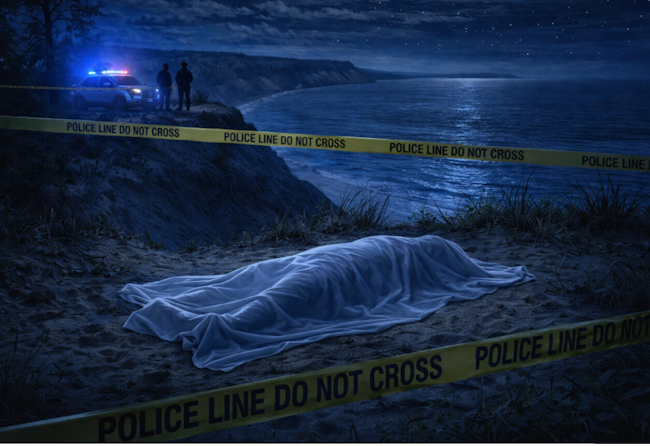
The following day, September 2, a visitor walking along the Lake Michigan shoreline discovered a body lying on the sand below a bluff near Frankfort. Authorities initially believed the boy had drowned — a tragic but not unheard-of fate in a beach community.
That assumption would soon unravel.
The Autopsy That Changed Everything
An autopsy revealed something deeply troubling: Terry Sutter had not drowned in water.
Instead, medical examiners found large quantities of sand in his lungs, a condition known as massive sand inhalation. Investigators concluded Sutter had suffocated — likely buried in sand or forcibly held beneath it.
Bruising covered his body.
Family members later said the injuries were so severe that Sutter’s grandmother demanded an open-casket funeral so the community could see what had been done to him.
The case was reclassified as suspicious, then eventually as a homicide.
Evidence on the Bluff
Investigators focused on the bluff above the beach where Sutter’s body was found.
There, police recovered:
- A six-pack of Busch beer (three empty, three full)
- Cigarette butts
- Flattened grass, suggesting people had been sitting or struggling
A friend later told police he had purchased the beer for Sutter earlier that evening.
More troubling was what wasn’t found.
Sutter’s shoes and socks were never recovered. His pants turned up days later — not near the beach, but on the Frankfort pier, raising suspicions they had been intentionally placed there.
Witnesses, Rumors, and Fear
Almost immediately, witnesses began coming forward — quietly.
A tourist reported seeing what appeared to be a body being removed from a vehicle near the beach that night. A young woman reportedly told a friend, “I can’t believe what they did to Terry Sutter.”
Over the years, investigators documented numerous statements suggesting Sutter may have attended — or been lured to — a late-night gathering before his death.
According to later police records obtained through Freedom of Information Act requests, multiple individuals claimed Sutter was beaten and then thrown from the bluff, still alive, before being suffocated under sand.
Some witnesses alleged he was silenced because he had seen illegal activity. Others suggested the killing was triggered by something as seemingly trivial as scratching an expensive car.
None of these accounts were ever corroborated strongly enough to support charges.
What was consistent, however, was fear.
At least one teenager later told investigators he had been threatened with death if he spoke about “the Sutter boy.”
A Grand Jury and a Second Autopsy
In 1986 — thirteen years after the killing — Benzie County authorities took a rare step.
A one-man grand jury was convened to review the case. Terry Sutter’s body was exhumed for a second autopsy. The ruling was firm: homicide.
Hundreds of statements were reviewed. Dozens of witnesses were questioned.
Still, no indictments were issued.
Officials acknowledged that time, intimidation, and fading memories had compromised the investigation.
A Town That Never Forgot — Or Fully Spoke
While the case never officially closed, it slipped into a kind of suspended silence.
Sutter’s grave became a disturbing symbol of that silence. His headstone was repeatedly vandalized — smashed, overturned, destroyed. Eventually, the family removed it entirely.
Today, Terry Wayne Sutter lies in an unmarked grave.
In later years, journalists attempting to revisit the case reported receiving warnings to stop asking questions. Community members spoke in whispers, if at all.
Renewed Efforts and Modern Attention
The Michigan State Police revisited the case in the 1970s. Local task forces reopened it again in 2009 and 2010, establishing a tip line and re-interviewing witnesses.
Sheriffs over the years publicly reaffirmed their belief that someone in the community knows what happened.
In the 2020s, national true-crime media reignited attention. Podcasts and investigative journalists brought Sutter’s story to a new audience, prompting renewed calls for information.
Despite the attention, no arrests have followed.
A Case That Still Demands Answers
More than 50 years later, the murder of Terry Wayne Sutter remains unsolved — not for lack of effort, but perhaps because fear and silence proved stronger than justice.
He was 15 years old.
He never got to grow up.
And somewhere, investigators believe, the truth still exists — buried not in sand, but in memory.
Authorities continue to urge anyone with information, no matter how small or delayed by time, to come forward.
Because cold cases do not fade.
They wait.