


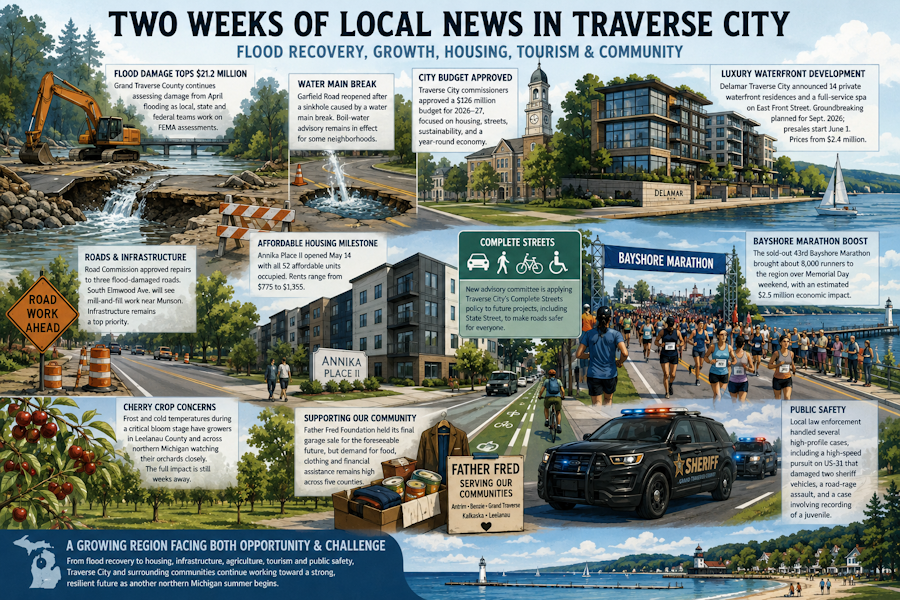
TRAVERSE CITY — The unofficial start of summer arrived in the Grand Traverse region with a familiar mix of visitors, road work, waterfront development and seasonal optimism. But beneath the Memorial Day weekend activity, the past two weeks of local news have pointed to a community still dealing with the aftershocks of spring flooding, a tight housing market, expensive infrastructure needs and uncertainty for one of northern Michigan’s signature crops.
The biggest continuing story is the cost of April’s flooding. Grand Traverse County’s preliminary damage estimate has now reached $21.2 million, according to county emergency officials, with local, state and federal teams still reviewing damaged roads, bridges, parks, utilities and private properties as part of the process for possible FEMA disaster funding.
That figure gives the region’s recent news a through line: Traverse City and its surrounding communities are trying to prepare for a busy summer season while also repairing what spring left behind.
The flooding story is no longer just about washed-out roads or immediate closures. It is becoming a longer-term question about public infrastructure, river health, recreation access and the price of resilience. The Ticker reported this week that local officials are weighing what the flooding could mean for Boardman-area recreation and the health of the river system, while the county continues assessing the full scope of damage.
Roads have been one of the clearest public-facing impacts. The Grand Traverse County Road Commission recently approved repairs on three flood-damaged roads after public discussion, according to 9&10 News. Meanwhile, the city is also moving ahead with planned maintenance work, including closures on South Elmwood Avenue between West Front and West Eleventh streets for mill-and-fill work near Munson.
Those disruptions collided with a holiday weekend that typically brings thousands of people into Traverse City.
A water main break added another complication just before Memorial Day weekend. Garfield Road reopened after a sinkhole caused by a water main failure, but 9&10 News reported that neighborhoods including Traditions and Birmley Estates were under a boil-water advisory after the break. The incident was a reminder that even as the region prepares for summer visitors, basic infrastructure remains vulnerable to sudden failures.
At the same time, Traverse City is attempting to plan beyond the immediate repair list. City commissioners approved a roughly $126 million budget for the next fiscal year, with spending aimed at housing, street projects and other long-term priorities. The budget covers the fiscal year beginning July 1 and is tied to broader city goals including environmental sustainability, year-round economic activity, placemaking and public infrastructure.
The budget action came after earlier public discussion of the city’s first 2026–27 plan, which was organized around six strategic pillars and also included budgets for Traverse City Light & Power and the Downtown Development Authority. In practical terms, the budget debate showed how many of Traverse City’s major issues now overlap: roads are connected to growth, growth is connected to housing, and housing is connected to whether workers can afford to stay in the area year-round.
Housing remained one of the clearest examples of that pressure.
Annika Place II, a new affordable apartment complex on Hastings Street, opened this month with all units already occupied. UpNorthLive reported that the project opened May 14 and had a growing waitlist, underscoring how quickly income-restricted or lower-cost units are absorbed in the Traverse City market.
The opening was a milestone for affordable housing advocates, but the fact that the building was full immediately also showed the depth of unmet demand. In a region where tourism, service work, health care, education and seasonal industries all depend on local workers, the shortage of attainable housing continues to shape nearly every major public conversation.
On the other end of the housing market, Delamar Traverse City announced plans for luxury waterfront residences on East Front Street. 9&10 News reported that the project would bring private waterfront homes, a spa, a shared rooftop and access to select hotel amenities.
Together, the Annika Place II opening and the Delamar announcement captured the split-screen nature of Traverse City’s housing economy. One project shows the demand for affordable apartments. The other shows the strength of high-end waterfront real estate. Both are part of the same growth story, but they serve very different segments of the market.
The city is also looking at how people move through Traverse City as growth continues. A new Complete Streets Advisory Committee is beginning work on how to apply Traverse City’s Complete Streets policy, which is designed to make roads safer and more usable for drivers, pedestrians, cyclists, wheelchair users, children and seniors. 9&10 News reported that the policy is being applied to future road planning, including corridors such as State Street.
That work matters because Traverse City’s transportation debates are no longer only about traffic volume. They are about how downtown, neighborhoods, schools, medical facilities, businesses and the waterfront connect to one another. As more housing is built and more visitors arrive, street design becomes a quality-of-life issue as much as an engineering issue.
Tourism was also back in the spotlight. The sold-out Bayshore Marathon brought an estimated 8,000 runners to Traverse City over Memorial Day weekend, with a projected local economic impact of about $2.5 million, according to 9&10 News.
For hotels, restaurants, retailers and service businesses, the marathon is an important early-season boost. It also serves as a preview of the region’s summer rhythm: packed roads, busy beaches, full dining rooms and a local economy that relies heavily on visitors. The race’s economic impact shows why event tourism remains so valuable to Traverse City, even as residents continue to debate congestion, parking, infrastructure strain and affordability.
Agriculture added another layer of uncertainty during the same period. In Leelanau County and elsewhere in northern Michigan, cherry growers have been watching frost and cold temperatures during a critical point in the growing season. UpNorthLive reported that growers were monitoring orchards closely as cold weather and frost raised concerns about possible damage.
That concern followed earlier reporting from Antrim County and northern Michigan that fruit growers were already watching cold weather as trees began to bloom. The final impact on the cherry crop may not be clear for weeks, but the risk matters far beyond individual farms. Cherries are part of the region’s agricultural economy, tourism identity and cultural brand.
The agricultural story also fits into a larger pattern: northern Michigan’s economy is deeply seasonal, and weather can shape everything from orchard yields to road repair schedules to recreational access.
Public safety and courts also produced several notable headlines. The Ticker reported on a Traverse City man charged after a high-speed pursuit on US-31 that damaged two Grand Traverse Sheriff’s Office vehicles, along with separate cases involving an alleged road-rage assault and a man charged with recording a juvenile.
Those incidents did not define the news cycle the way flooding, housing and infrastructure did, but they contributed to a busy stretch for local law enforcement and courts.
The region also saw community and nonprofit news with broader implications. The Father Fred Foundation held what was described as its final garage sale for the foreseeable future, even as demand for services remains high across Antrim, Benzie, Grand Traverse, Kalkaska and Leelanau counties. UpNorthLive reported that Father Fred continues to provide food, clothing, financial assistance and pantry support across the region.
That story matters because it points to another side of the local economy. Traverse City’s public image is often shaped by tourism, restaurants, lakefront homes and festivals, but nonprofits continue to see residents who are struggling with food, housing, utilities and basic needs.
Taken together, the last two weeks of news show a region balancing opportunity and strain.
There is investment: a major city budget, new housing projects, luxury development, public street planning and a major holiday-weekend race. There is also vulnerability: flood damage, water main failures, construction disruptions, crop risk and persistent affordability concerns.
The coming weeks will likely determine how several of these stories evolve. County officials will continue seeking clarity on flood recovery and possible disaster assistance. Road repairs and city projects will affect traffic as summer intensifies. Housing demand will remain high even with new units opening. Farmers will get a clearer picture of frost impacts. And Traverse City will move from Memorial Day weekend toward the peak summer season, when the region’s strengths and stresses become most visible.
For now, the story of Traverse City and the surrounding counties is not one single headline. It is a convergence: a growing destination community trying to repair damage, manage growth, house workers, protect agriculture and keep everyday infrastructure functioning as another northern Michigan summer begins.