


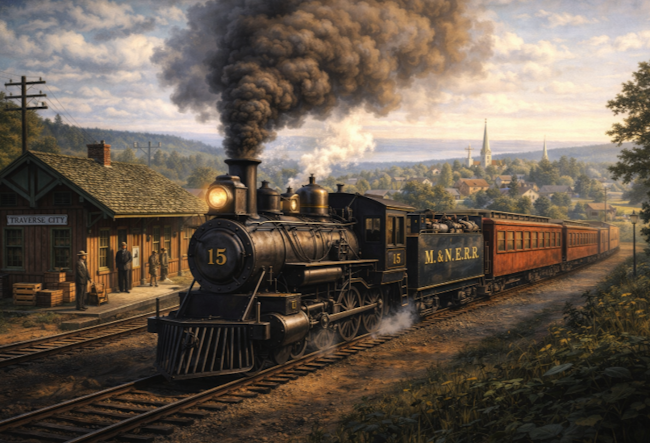
For more than four decades around the turn of the 20th century, railroads were among the most important forces shaping northern Michigan — socially, economically, and geographically. In particular, the Manistee and North Eastern Railroad (M. & N. E. R. R.) played a central role in connecting Traverse City to surrounding communities and the wider world.
The Golden Age of Railroads in Traverse City
How the Rails Helped Build the Region and Why They Disappeared
Origins and Purpose
The railroad was formally organized in January 1887 at a meeting of lumber industry principals William Douglas and Edward Buckley in Manistee, Michigan. Their goal was straightforward: build a railroad from Manistee to Traverse City, roughly 75 miles, to move logs and lumber from the rich forests of northern Michigan to the large sawmills on Lake Michigan.
Construction began in the spring of 1888. By October 1888, the line was handling freight to Onekama, and it continued extending northward through the following years:
- April 1889: tracks reached Kaleva and Lemon Lake
- September 1889: Nesson City
- June 1890: Interlochen
- October 1890: Lake Ann
- June 1892: finally extending to Traverse City
The railroad was built with standard-gauge track, which was more durable and compatible with larger national rail systems than the narrow gauge used by many logging lines. From the start, it was designed for quality, not just utility — heavy rails, well-built cars, and passenger coaches that were described in the press as “equal to the best of the Chicago and West Michigan” for comfort and construction.
Passenger Service and Early Growth
Initially, the M. & N. E. carried only freight. But by January 6, 1889, the first passenger train ran from Manistee up to Bear Creek — though that was still early in the railroad’s construction. Additional passenger cars were soon added as demand grew.
The railroad became a social bridge between towns. Locals didn’t just ride it for transportation or commerce — they rode it for:
- shopping trips
- business travel
- hunting and seasonal excursions
- visits to markets and fairs
In its heyday — around 1915 — the M. & N. E. carried 190,000 passengers a year and was widely regarded as a high-quality operation for its size.
Freight, Agriculture, and Regional Impact
While lumber was the railroad’s original economic engine, its role evolved as timber supplies diminished. The wealthy pine forests around Lake Ann gave way to agriculture, especially potato farming, which became a major freight customer. Boxcars filled with local produce would be spotted beside sheds near the tracks, ready to ship to distant markets.
Branches were also extended from the main line, including lines north toward Northport, west toward Empire Junction, and east toward Grayling by 1910 — expanding the railroad’s reach and supporting more regional industries.
At its peak around 1910, the railroad owned 355 miles of track, 15 steam locomotives, snow plows, and a full set of passenger and freight cars.
The Decline of the Rails
By the 1920s, the rise of the automobile and improved roads began drawing passengers off the rails. Freight too shifted as local industry patterns changed. By 1921, daily passenger service had reduced from two trains each way to only one.
In 1931, the railroad — renamed the Manistee and Northeastern Railway — was taken over by the Pere Marquette Railroad. The shift marked the beginning of its decline.
Between 1931 and 1934, sections of track were gradually abandoned. By July 1934, the last freight train departed Lake Ann, and the right-of-way between Kaleva and Solon was taken up. The Traverse City depot closed later that year, and tracks were removed by the fall of 1934.
Many of the old depots and facilities were later torn down; for example, the Lake Ann depot was demolished in 1935 to make room for civic construction.
Legacy and Remnants Today
Though the trains have long stopped running and tracks have largely vanished, the railroad’s imprint remains:
- Segments of the old rail right-of-way can still be walked or explored through fields and woods near Grand Traverse.
- Historic records and photographs preserved by local libraries, museums, and history enthusiasts keep the memory of the railroad alive.
- Some later 20th-century rail uses, including the Grand Traverse Dinner Train (1996–2005), reflect a cultural nostalgia for rail travel in the region, even after regular passenger service ended decades earlier.
Most importantly, the railroad’s presence played a critical role in the formation and growth of multiple towns between Manistee and Traverse City — shaping settlement, commerce, and community life during Michigan’s logging and agricultural booms.
Quick Facts
- Organized: January 1887 by William Douglas and Edward Buckley.
- First freight operation: October 1888.
- First passenger train: January 6, 1889.
- Reached Traverse City: June 1892.
- Peak passenger service: ~1915 (190,000 passengers).
- End of passenger service: By early 1920s, reduced; later ended entirely.
- Last freight to Lake Ann: July 1934.
- Tracks removed: By October 1934.