


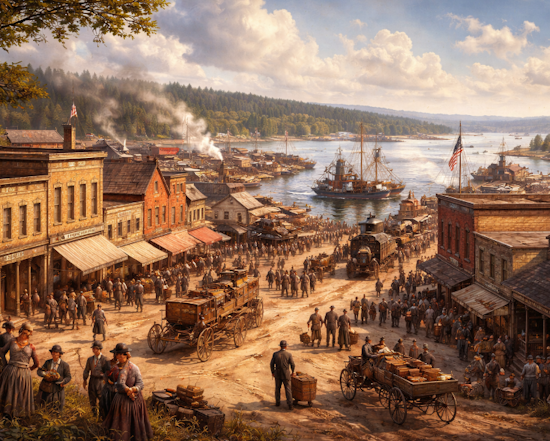
TRAVERSE CITY, Mich. — In the latter half of the 19th century, the small settlement along the shores of Grand Traverse Bay began transforming into one of northern Michigan’s most important regional centers, driven by lumber, transportation, and strategic location.
The community that would become Traverse City traces its formal beginnings to the early 1850s. In 1853, the settlement received its first post office under the name “Traverse,” a key milestone that signaled permanence and connection to the wider world. Around this time, Albert T. Lay and Perry Hannah established a sawmill near the bay, laying the foundation for the town’s first lasting industry.
Lumber quickly became the economic engine of the area. The surrounding forests of white pine supplied sawmills that shipped timber by water and rail to growing cities throughout the Midwest. As the industry expanded, workers and their families arrived, transforming the once-isolated settlement into a growing town.
Transportation played a critical role in Traverse City’s rise. Its deep natural harbor allowed ships to load lumber directly from shoreline docks, while the arrival of railroad connections in the late 19th century further cemented the city’s importance. These transportation links made Traverse City a supply and distribution point for surrounding communities throughout Grand Traverse County.
By the 1880s and 1890s, Traverse City had developed essential civic institutions, including schools, churches, businesses, and local government. Brick buildings began to replace early wooden structures in the downtown area, reflecting both economic stability and lessons learned from fires that had devastated nearby villages.
Traverse City was officially incorporated as a city in 1895, marking its transition from frontier settlement to established municipality. At the time, it served not only its own residents but also acted as a commercial, legal, and cultural center for much of northern Michigan.
As the lumber era declined in the early 20th century, Traverse City adapted once again. Agriculture — particularly fruit farming — and tourism emerged as new pillars of the local economy, ensuring the city’s continued growth.
Today, Traverse City’s streets, harbor, and historic buildings still reflect the forces that shaped its early development. What began as a modest lakeside settlement evolved, through industry, transportation, and resilience, into a community that continues to anchor the Grand Traverse region.