


Traverse City, Michigan — Circa 1853
Traverse City’s early roots trace back to the dense pine forests and abundant timber resources of northern Michigan — but one man’s vision would shape its destiny.
In 1851, Perry Hannah, a young lumberman from Pennsylvania who had gained experience in the flourishing Chicago lumber trade, joined forces with partners A. Tracy Lay and James Morgan to purchase land at the mouth of the Boardman River and establish Hannah, Lay & Company. There, the team revitalized a small sawmill originally built by a local landowner and began extensive logging operations in the surrounding forested lands.
Under Hannah’s direction, the sawmill and its associated operations attracted workers, families, and investment to the area. By 1853, with enough settlers calling the place home, the U.S. Post Office authorized a new office at the site of the mill settlement. Though initially proposed as “Grand Traverse City,” the name was shortened to Traverse City — a name that survives to this day.
Hannah’s influence extended well beyond lumber. As the community grew, his company became the region’s largest employer, providing jobs, goods, and services that fueled expansion. The partners built one of Traverse City’s earliest general stores and its first bank, helping establish a commercial center around Front Street.
A shrewd and generous leader, Hannah also helped secure vital infrastructure and institutions for the young settlement. He donated land and financial support to bring rail service to town and successfully lobbied to locate the Northern Michigan Asylum — now the Traverse City State Hospital — in Traverse City, bringing jobs and state investment.
When Traverse City was formally incorporated as a village in 1881, Perry Hannah became its first village president, later serving multiple terms and then becoming the city’s first mayor after its incorporation in 1895. His leadership over decades helped transform Traverse City from a remote lumber camp into a vibrant hub of commerce, governance, and community life.
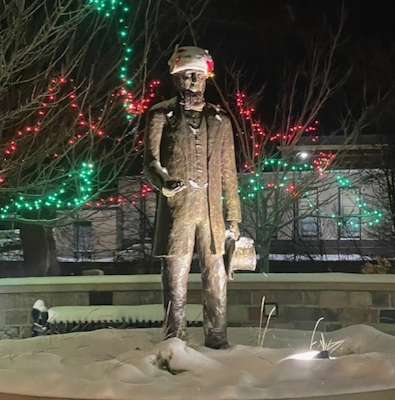
By the time of his death in 1904, Perry Hannah had left an indelible mark on the city he helped build. Today, landmarks like Hannah Park, the historic Perry Hannah House, and a bronze statue in Perry Hannah Plaza stand as reminders of his foundational role in Traverse City’s history.